Showing posts with label inspiration. Show all posts

20140521

Don't Forget Your Uppercut


Growing up in the ‘80s or ‘90s, it was a well-known fact that the “start” button paused any and all video games. However, there was one glorious exception to this rule: the uppercut in Punch-Out!

For those who never knew its exhilarations, Punch-Out! was an extremely popular boxing game on NES in which players entered the ring as Little Mac, a pint-sized runt who, through some highly unethical breach of WBA regulations, faced a series of monstrous opponents two or three times his size.


But Little Mac had two advantages: first, his determination to fight and win; and second, the human being controlling him.


Still, once the bell rings and Mac’s first opponent ambles forward, apprehension never fails to kick in. The fact is, the guys you face in this game are huge. Some of them can make mincemeat out of Mac with just a few punches. Mac’s punches, on the other hand, come off as depressingly anemic. Then again, what more could you expect from a guy who has to jump a foot in the air to reach his opponent’s chin? But this little guy is not without his trump card.


Into this daunting situation, Digital Providence has tossed a happy surprise: Mac’s signature move, the spinning uppercut. It takes a lot out of Mac, and is only possible when his confidence is up after scoring a particularly effective shot against an opponent—but when he’s able, Mac spins around, spirals into the air in a dazzling five-foot vertical leap, and drives his little fist straight into the adversary’s unsuspecting face. All this is triggered by pressing the “start” button.


This is quite literally a game-changing punch that has the power to instantly lay out some opponents. And when it’s timed right, this baby is still—in the age of ultra-HD graphics and super-intuitive game engines—still one of the most satisfying moves in all of Video-Gamedom.

So why bring it up now, other than nostalgia?

Sometimes I feel like Little Mac. You know what I mean. Up against huge problems, thinking things like, “I am way out my league here!” or “I shouldn’t even have to deal with this!” or “Why am I boxing with a mutated, 300-pound hippo-man?” Well, okay, only Little Mac has thought that last one, but we’ve all been in the ring with people or problems that seem to vastly outweigh us. And we have felt that primal fear, that deep sense of inadequacy.

It is at these moments that we need to remember the spinning uppercut. There is power, there is greatness, placed within you. Find it and claim it. Don’t be afraid to use it. Never fear greatness, because greatness is your destiny.

And there is nothing more satisfying than feeling that spinning uppercut hit its mark!


Confidently,
Joezilla

20120314

Life's Classroom

One of the greatest things about life is that it offers quiet, whispered lessons every day. It takes a lot of willingness, a bit of inner peace, and a dash of grace to hear these lessons, but I know from experience that they're there for the taking. I offer today as a wonderful example.
I was blessed with a wonderful combination this morning: beautiful weather, crackling enthusiasm, and a large chunk of free time. Accordingly, I was able to spend a few minutes raking dead grass in the yard—and, I must add, enjoying the nature! All this would have been great, but God topped it all off with some wonderful inspirations. These are those little lessons I'm talking about. I hope you enjoy them, as well.


First, I realized as I raked that happiness comes with habits. Let me be clear here. We can all have a happy moment (for instance, winning the Lottery) or a happy experience (like a dinner with old friends). This is happiness as a feeling. True happiness, what I like to call deep happiness, is more of a trait that we can nurture or neglect, much like a muscle or a skill. Happiness must be exercised. Inner peace must be a goal. This starts with physical relaxation (not sitting in an easy chair, but striving for relaxed and unhurried motion in daily life--eliminating unnecessary tension in the body), but it also requires other work, both inside and out. Gratitude must be clung to like a lifesaver, because that is precisely what it is. G.K. Chesterton wisely observed that "Thanks are the highest form of thought." Acts of service should make visible the love we have for those in our lives. Of course, there's much more, but what I realized today was that happiness, like all good things (and some really bad ones!) requires habitual action.

The second lesson was about excess—and, if I may be bold, the nature of God. I was struck by the vibrant brightness of the day out there. The sky was not just blue, it was an insanely deep, bright, fall-into-it-if-you-stare-at-it-too-long kind of blue. The evergreens weren't just green, they were a glowing, smiling, healthy, look-at-me sort of green. The birds were boisterously chirping in some great treetop debate that somehow involved the whole neighborhood. The whole of nature seemed so happy. I was filled with inner peace.


But that's the strange part--this scene was anything but peaceful on the outside. My eyes were buffeted with light and color, my ears were filled with wind and cheep-cheeps. But it soothed my spirit. Why? Well, I think it's because our God is not one of moderation. Moderation is an earthly concept, and a blessed one--it frees us from the captivity of our humanity, allowing us to set our sights on something higher than our animal impulses and desires. Moderation is one of our greatest defenses against evil. But once this life is over, moderation, I think, will be a thing of the past. If Heaven is placement in a divine family typified by perfect Love, who needs to be moderate there? I think Heaven will be excess, in the best sense of the word--God's love filling each member of the Kingdom to a degree that is now unfathomable to our mortal minds. For now, all we can do is marvel at the blue skies He sends us.


The final insight came from a quick climb of a tree. Ascending about 25 feet into the air, I was treated to an unusual perspective on the surrounding neighborhood. Seeing the trees, houses, and particularly the street from such an unusual angle flipped a switch in the back of my mind, and reminded me just how amazing everything really looks. The smooth curves of the road, expertly planned by some engineer decades ago, jumped out at me in a way I never appreciated while driving them. The houses, too, looked novel and fascinating from this unorthodox altitude.


Although I soon lost sight of this valuable perspective-shift, I remembered it while driving later in the day--and that strange elevated view of the road came back to my mind; suddenly, I was no longer just driving back from school, but instead driving on a strange and fascinating trip to a wonderful destination. That physical shift in perspective reminded me to appreciate all experience as unique. I'm indebted again to G.K. Chesterton, who said that "Every instant of conscious life is an unimaginable marvel." How true, indeed!


See what a little sunshine can do? =)


Happily,


Joezilla

20101224

Christmas, The Bishop's Wife, and True Service


Hello there, and Merrrrrrry Christmas!

o<(:})>

In case you were wondering, dear reader (if, in fact, there is any dear reader out there to be wondering), the seemingly unintelligible jumble of symbols above is my patented new Santa Smiley (all rights reserved, of course!). If you're puzzled by this moniker, look at it sideways and everything will make sense. Ho-ho-ho!

Today I just watched the wonderful Christmas film The Bishop's Wife, starring Cary Grant, David Niven, and Loretta Young. It's a wonderful movie that could be best characterized with a single word: charm. The actors are charmingly entertaining—funny when they're supposed to be funny, touching when they're supposed to be touching, and at all times quite convincing in the clever little plot the movie relates.

It is a great film from a great era of film-making, but this is not what puts it over the top. On the contrary, the greatest charm of this movie comes in its superb and enlivening message.

I firmly contend that the best entertainment is the kind that makes us want to be better people. The best book is the book that, upon its finishing, causes the reader to throw it to the ground, jump up in a fit of ecstasy, and embark on some great adventure that will somehow better the world. The best song is that which grants its listeners a supernatural sort of energy upon hearing it or even thinking of it, the kind of song that galvanizes the dazed denizens of the doldrums (we've all been there) and renders them ready for righteous battle on some unknown front in the war of their own life. And the best movie is the kind that gives us a larger view of life—one that, by means of its broadness and great perspective, provides us with creative new solutions to old problems...as well as the hope and inspiration to carry out such ambitious endeavors.

The Bishop's Wife is just such a movie. Its headlining actor, Cary Grant, plays the role of the angel Dudley (what a great name for an angel!) with a paradoxical mix of vivacity and restraint—two typically contrasting traits effectively united by a peaceful air of sheer goodness—showing us a character who has an overwhelmingly positive effect on everyone he encounters. We can't help but be won over by Dudley as we see him in action, spreading faith and honesty with every word he utters and every move he makes. And there's a part of each one of us that longs to be like him—to be connected to God with such a firm bond as to walk each day with supreme confidence as we do good work.

Of course, there is more to this movie than merely an inspiring character (which is easily enough to carry a movie on its own—see Jimmy Stewart's Harvey if you need some convincing). The greatest message of the movie arrives in its final scene, as David Niven's Bishop Henry delivers one of the most poignant, effective, and spot-on Christmas messages Hollywood has ever produced. Here it is, in its entirety:


Tonight I want to tell you the story of an empty stocking.
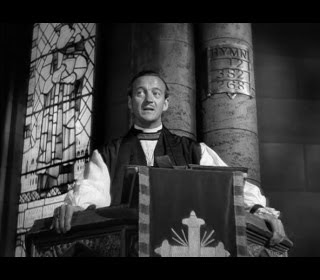


Once upon a midnight clear, there was a child's cry, a blazing star hung over a stable, and wise men came with birthday gifts. We haven't forgotten that night down the centuries. We celebrate it with stars on Christmas trees, with the sound of bells, and with gifts.

But especially with gifts. You give me a book, I give you a tie. Aunt Martha has always wanted an orange squeezer and Uncle Henry can do with a new pipe. We forget nobody, adult or child. All the stockings are filled—all, that is, except one. And we have even forgotten to hang it up. The stocking for the Child born in a manger. It's His birthday we're celebrating. Don't let us ever forget that.

Let us ask ourselves what He would wish for most. And then, let each put in his share: loving kindness, warm hearts, and a stretched-out hand of tolerance. All the shining gifts that make peace on earth.


What we see here is a call to action, in the greatest of spirits. It is a call to service, but not the kind of service we typically think of. The sermon does not explicitly tell us to go to Africa and feed the starving children (although many do, and render the world a great gift in doing so). It does not exhort us to go and build homes for disaster victims (although many do, and can joyfully make an irreplaceable difference in the life of a fellow human being in doing so). It does not command us to spend our every moment engaged in feeding the hungy at soup kitchens (although many do, and help provide a chance at success to countless souls in doing so). No, the sermon does not call us to anything that the world would call "great." It calls us to a different kind of service, a more fundamental one that can begin anywhere and continue into eternity—and, if put into practice, will change the world in a truer way than any work of human hands ever could.


This type of service begins in the heart, and consists of one simple step: Conduct yourself with love. Love for God, love for other people, and love for yourself. Mother Teresa summed it up quite well when she told us to Do small things with great love. If we conduct ourselves with love, then we will always produce good fruit in the world. Love the people you have contact with. Have faith that God made them and put them in your life for you to love them, as He Himself loves them. Love the places you frequent, the vehicle that transports you, the work that sustains your life. Love your church and your God, and don't ever forget to love yourself. If you find yourself looking in the mirror and finding that there isn't much to love, do two things:


1. Realize that as a creation of God, you are fundamentally worthy of love, no matter how bad a person you have been. St. Paul wasn't lying when he said that Nothing can separate us from the love of God. You deserve to be loved by yourself, because you are already loved by God—no matter what! Right the wrongs and move forward in confidence.


2. If there are flaws in your character that seem unlovable, change them! Resolve to change them, out of love for Him Who created you, out of love for those who must deal with your flaws, and out of love for you, who deserve to enjoy a higher, more successful existence. Choose to be dynamic.


"Conduct yourself with love." Of course, this is not a new message. Certainly it appears countless times in the New Testament. But seeing a movie like The Bishop's Wife is a great modern wrapping of this timeless message, a message that seems all too forgotten in the world.


This Christmas, and all the time, I commit myself to doing this kind of service as much as my fractured human awareness permits me—and I hope that you will do the same, dear reader.


I would like to invite you to join me in renewing a little Yuletide tradition that I previously kept in my personal journal, but sadly neglected to continue last year. The tradition, which I'm glad to have you aboard for, is that of writing and reading a prayer at Christmastime. Regardless of whether or not you are "a praying man," to quote George Bailey in It's A Wonderful Life (it's a wonderful movie), I invite you to read through this. If you believe in God, then you know that praying this will do good things for the world. If you don't believe, then what's the harm in saying a few words? It would mean a lot to me. Here, let's begin:


Dear Father in Heaven,


On behalf of humanity, thanks for the awesome Christmas present! You came to us as a man, entering this world by the same way that all of us enter, coming as a baby. In the beautiful birth of that baby, You were and are the greatest Christmas present of all. Help us to realize that. Help us to listen deeply to the carols that tell of your birth, and grant us insight into what your coming really means for all of us and for our salvation.


We pray that you will not let us forget the small changes of mind and heart and hand that can make the world's difference for the person next to us—the smiles on our lips, the warmth in our tone of voice, and the fire of love in our hearts. May Your spirit ignite and rekindle that fire in our hearts, and may we be open to this nourishing flow that connects our human hearts with Your sacred heart.


And may we never forget the sacrifices of those who make us happy at Christmas and throughout the year—sacrifices that imitate the ultimate sacrifice you made for us up on Calvary hill. That was the final act of the life that began on the first Christmas night. Let us not forget that, either.


But most of all let us not forget that the life that began on that first Christmas still continues to this day—and the jolliest Christmas spirit is merely a reflection of that original Gift, the Gift Who changed the world. Let our faith in You nurture a servant's heart in all of us, that we may serve the world each in our own way, and help our fellow humans to have a Merry Christmas and the Happiest of New Years!


We ask all of this in Your name, Jesus.


AMEN.
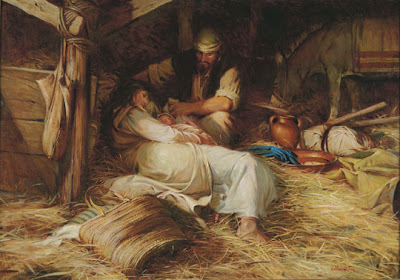

Merry Christmas, and here's to the best New Year yet!


With Christmas Love,

Joezilla

20101007

Guided Drift and the Paradox of Faith

"I am glad that I've been able to do what I've done and not been sidetracked along the way. A teacher of mine calls it guided drift. Isn't that wonderful? You're drifting, and yet you've got a rudder."


As Mr. Rogers so satisfyingly puts it in the quote above, life becomes a positive pleasure when we know where we're going and allow this knowledge of our course to give us peace. In order to live effective lives we need to have a purpose, a continuous thread that unites our individual days into a coherent work. That is why Mr. Rogers talks about having a rudder. We need to guide ourselves, and we need to rely on something to give us that guidance.

For a long time I looked at life believing that we all have some inspired moments, and we also have a great many uninspired moments. We must live (so I thought) on those inspirations to get us through the uninspired periods of life, which are far more common. There is a grain of truth in this. We do have peak experiences of happiness, hope, promise, joy, and love—followed by the proverbial descent back to planet Earth, in which we remember our troubles (and perhaps feel a little gloomy that we aren't so inspired anymore).

That said, I now realize that it is not enough merely to live on the inspired moments, like rations on a trip through the desert. No, I believe that God calls us to something greater than that. You see, people living solely on previous inspirations—and waiting for future ones—are not focusing on the day-to-day business of life. They are attaching themselves to that song that used to empower them so much, or they are voraciously rereading that one quote that used to give them such confidence, or talking to that one friend who always cheers them up...the list goes on and on. The point is, they are chasing that feeling rather than living it out. They could be cheering someone else up. Instead, they're focusing on how much they themselves need cheering up.

One of the greatest pieces of advice my Mom has ever given me is: "The best solution for depression is to do something for someone else—to get out of yourself." It is so true, and will doubtless lead to better spirits if we are feeling depressed.
But what about all the moments inbetween the highs and lows? What about the average days, when we drift through our daily grind with no sense of inspiration or mission? We need some thread of constancy to call us back to living our best.

The answer, as is often the case, lies in a common word with a life-changing meaning:

FAITH.

Faith is the answer. Now when I say "faith," I don't just mean "religious belief." I am talking about a lifestyle—a worldview that we can call up with an act of the will, and should work to maintain in every waking (and sleeping) moment. If we can manage to make it part of our modus operandi, it will change our lives—I'll place a 100% guarantee on that.

This worldview has two big components.

The first is the consciousness of God and His plan. The person of faith believes, deep inside, that there is a God Who loves us all and Who has a plan for every individual—a plan that, if followed, will bring them to the self-fulfillment of their highest dreams and deepest longings. I say "self-fulfillment" because we play a role in this plan. We create our own reality, at least in terms of how we respond to the outside world.

But the person of faith can take all of this in stride and proceed peacefully because he knows that if he follows God's commands, then things will go rightly for him. Life will be good. Unexpected events may happen (look at the story of Job!), but God has a plan. We can move forward in peace and happiness, because it all turns out okay in the end. It's pretty amazing, actually. Imagine being able to walk through life in perfect peace. In theory, we can do just that—because God has told us that He loves us and wants the best for us.

That's one part of faith. The other is prayer. God loves us, and wants the best for us. He also wants us to grow closer to Him. One way of describing Heaven, in fact, is a perfect relationship with God. Nothing gets in the way. We remain ourselves, but we are united with Him in some unimaginable and infinitely wonderful way.

But that comes later. Right now, stuff gets in the way. Lots of stuff. Problems, people, things, emotions, sins...the list once again goes on and on! But God has given us ways around these impediments. One of the foremost of these—one of the most foundational practices for a Christian—is prayer. Praying is communing with the Creator. It's a way of accepting His constant, daily calls and saying, "I love you too, God. Now what do you want to tell me today?"

For years, I have vastly underestimated the transformative potential of prayer in the individual life. But now I see that prayer is that thread of constancy. It is what keeps us close to God, even in the midst of struggles. Saying the Rosary or part of the Rosary (a decade or two) every day is such a great way to do this. It will have a lovely effect on your life. Fulton J. Sheen once described saying the Rosary as "saying 'I love You' to our Father." I believe he was right. If you've never prayed the Rosary before, feel free to check out this link for all the instructions and prayers: http://www.rosary-center.org/howto.htm.


Now, I know what you're thinking (if indeed there is anyone out there to be thinking anything): "Great. You've pontificated on faith, but you haven't answered the question of how we stop the roller coaster ride of ecstatic highs, gloomy lows, and wishy-washy times inbetween. I don't think that talking about faith means I'll never feel down again."

Ah, but therein lies the paradox of faith! Faith is not about inspiration or emotion. Faith is believing that your spiritual life is significant, that what you pray makes a difference. Faith is believing that when you pray—whether you feel inspired or not—you are doing something of unfathomable significance. Faith is a lifeline that carries us through whether we are experiencing a high, a low, or a "sideways." It does not guarantee us a life of constant inspiration, but it allows us to avoid that need altogether—because it gives us a higher perspective on life. When we lift our concerns up to God, He lifts us up too.

It's all about that guided drift Mr. Rogers talked about. Faith is our rudder, our guide, but it also gives enough peace to let us drift.

Here's to an hour, day, week, month, year, and life of guided drift,

Joezilla

20100205

Today is Tomorrow

“It’s gonna be cold, it’s gonna be gray, and it’s gonna last you for the rest of your life.” So testifies Phil Conners, world-class meteriologist and full-time jerk, in one of his lowest moments in the wonderful movie Groundhog Day. Whether or not we agree with Phil’s prediction tells us a lot about how we are currently seeing the world.

Phil’s is a unique tale; he goes to wintry Punxatawney, Pennsylvania to cover the annual Groundhog Day festivities, dutifully does his drudgery, then goes to sleep. He wakes up the next morning to a cold Punxatawney morning…a cold and familiar Punxatawney morning. Yes, as you probably already know (unless you have not seen the film, in which case you are seriously missing out), Phil is forced by the powers-that-be (in this case, it’s writer-director Harold Ramis) to relive the same day, over, and over, and over again.

How long is Phil trapped in this temporal wasteland? Months, maybe. Probably years. He’s there long enough to learn the quirky backgrounds of almost every citizen in Punxatawney, long enough to become a semi-pro piano-player, and long enough to become a trilingual aficionado of classic literature. And oh yeah, long enough to devote himself to a noble purpose—in fact, the noblest purpose anyone can dedicate himself to: self-improvement for the sake of others. But before he does any of that, he first attempts to wring out every inch of “fun” that he can from Punxatawney. It feels great at first, but soon the superabundance of, well, pretty much anything he wants, reveals the true emptiness of temporal pleasures.

The turning point comes when Phil talks to his pretty (and practically perfect in every way) producer, Rita. Convinced of his predicament, Rita offers this bit of advice: “Perhaps it’s not a curse. Maybe it just depends on how you look at it.” Phil promptly wakes up the next day and brings his co-workers coffee and pastries to enjoy amidst the bustle of their morning labor. In doing so, he begins the long and determined climb out of the hole he’s dug for himself, and at this point demonstrates a fundamental and potentially life-changing truth: kindness is a universal language. People worry too much about social niceties and clever turns of phrase, but Phil shows that an action fashioned from consideration and performed with kindness needs no fancy social wrapping. Be good, and everything else falls into place.

“As time goes by,” as they say, Phil builds himself into a true man—good-hearted, disciplined, and well-rounded (though, importantly, he remains as funny as ever). He takes up piano. He reads. He devotes himself, wholeheartedly it would seem, to serving others. Not a bad idea, Phil! It culminates in an epic day that seems to contain everything—music, dancing, snow-sculptures, a couple of saved lives…

Phil wakes up the next morning, and things are different. Can you imagine what it might feel like to live the same day over and over again for years, and then to wake up to a new one? Phil definitely shares the epithet of Dr. Manette in A Tale of Two Cities: RECALLED TO LIFE!

It should give us pause to realize that the universe, blessedly, doesn’t actually play tricks like that. We will go to sleep tonight, and we will wake up tomorrow, never to set foot on this date again. Perhaps that makes us want to seize this day, and that’s great. But more than that, I think it should make us appreciate the fact of tomorrow.

Think about it. You will wake up tomorrow, and there will be a whole new day ahead of you. What’s best, you will be able to act in that day, knowing that your good actions will have lasting consequences. Do you realize what a difference you can make in this world? Such great potential streams out of your every step; so be happy, wherever you are! As Phil says, incredulous, in the movie’s cheery final moments, “Today is tomorrow. It happened.” We all might benefit from saying that when we wake up to bright skies, gray or otherwise, in the tomorrow that never forgets to come. Today is tomorrow! Remember that!


And Winter slumbering in the open air,
Wears on his smiling face a dream of Spring!

(Samuel Taylor Coleridge)

Happy Groundhog Day!

Peacefully,
Joezilla

20090907

The Entry Where I Spoil Matchstick Men (I’m serious)


I am currently experiencing one of those splendid and rarefied spans of moments of complete confidence and sheer inspiration. If I may borrow one of J.K. Rowling’s best ideas without glorifying her too much, I have just drunk a bottle of Felix Felicis. I see the path of life drawn out before me; and though the route is as unclear as ever, I do possess the two real essentials to a successful journey; the first is a goal, which I have had for years, thanks to the Catholic religion I was born into and have embraced as the Truth. The second essential, bestowed upon me yet again by divine inspiration, is the more elusive, as it involves more than just a willful leap of faith and devotion. The second is the modus operandi, the method of working—which, God bless it, comes out from behind the clouds of uncertainty every now and then to shine its light upon us.

I just finished watching the movie Matchstick Men. It tells a tale of loss, illusion, and redemption, and reminds us that if we keep our noses clean (morally as well as legally), we never have to worry about much. It tells us the tale of an expert of deception who has nonetheless kept a portion of his soiled soul spotless, a man who receives a life-shattering dose of his own medicine when he is taken in by several who do not share his scrappy scruples, and thus have a slight edge in the crafty craft of con-artistry. In the end, Roy’s decency is what destroys him, or at least what he assumed was “him.” What we find out, in the crucial moments at his ex-wife’s door, when the depth of the deception finally hits home, is that—although his life lies in a shambles, with almost no money, no worldly credentials, and no real family—he is just fine. Indeed, as Roy himself iterates with a fledgling but hopeful confidence, “everything’s all right.” Out of the ashes of the two-bit Phoenix that was Roy’s former life as a con-man, we see the real Roy rise up; the Roy who forced himself to rationalize his spoils as “given, not taken,” the Roy who “never used violence,” the Roy who reached out to the nice checkout lady at the supermarket, like a withered plant inclining toward cracks of light through closed rafters. That is what carried Roy through to the end of his sinful life, and that, we finally see, is what carries him into the bright future. In the epilogue scene at the carpet store where Roy has built a clean livelihood, his brief meeting and parting with his “daughter” shows us that he has overcome any ill will which he might have held against his looters. We see a man who is free to fly because, in the words of G.K. Chesterton, like the angels he “can take himself lightly.” Matchstick Men reminds us that nice guys do not finish last—they may wind up in last place, but they always have time to work out of the hole and regain the good they were made for.

I suppose this movie just reminded me to be confident. After watching it, I realize I am ready to begin the next schoolyear. I feel like I can do exactly what I’m supposed to do. I’m excited to face opportunities to stand up for what I believe in, to proudly be the person God wants me to be; to be open to new possibilities, but also open to the mere continuation of old realities.

“To be content with where I am,
Getting where I need to be,
And moving past the past where I have failed.”


I am excited to exercise the grace which God has blessed me with this summer, to let the spiritual discoveries of these months germinate and flower into strong trees of good work and wholesome habits in my sojourns with the wider world. I am looking forward to the future months so intensely, and that is why my highest hopes are fulfilled by actually being plopped right here, in this moment, several weeks before all those busy days begin. One might say it is the final exam of summer school. Conventional wisdom, and Catholic theology, say that the way we finish the journey is the strongest indication of how we conducted it. Finishing strong is the only true reflection of a strong performance.

Did I learn anything this summer? Ha! How could I not have? I acted like an idiot enough (and felt bad about it) to learn quite a bit about compassion, authenticity, and honesty. At the same time, I also worked hard to build myself up, and thus learned the blessing and strength of good habits (and the easy poison of bad ones). I felt the push of a noble purpose and a steamrolling confidence drawn solely from the divine team I’m playing for.

I guess what I am trying to say is that these final weeks are the final test of this current crop of moments, and a sort of runway into the year. If I run this final stretch well, I will be ready to run the whole year. If I stumble, I may not get back up until next June. Spiritually speaking, that’s a long time down, way longer than I can afford.

So here I leave you, as always, at a crossroads; my decisions in the next few weeks will decide my ultimate destiny, of that I am sure. But then again, is that ever not the case?

Signing off with love and prayers for you,
Joezilla

20090725

Best Western (not a movie review!)

El Dorado is one of the best westerns there is. I like westerns. I like them because they teach me about life and how to live it. Here is how they do it.

First off, westerns tell stories of good and evil. They are complex tales of a simple conflict—just like life on this planet. No western is ever simple. In fact, the best ones place their heroes in unthinkably harrowing physical and moral dilemmas, often pitting survival against a principle. If you were sheriff of a fledgling western town, the one everyone looked to for protection, would you risk your life to fight a gang of outlaws for the sake of the town? What if your family’s lives were at stake? What if you could pay the outlaws money to go on to the next town? Would you do it? Here is what is great about westerns—they not only show us conflict between good and evil, but they show us what heroes do when placed in those conflicts. They show us the true courage, the selfless sort of bravery that risks life and limb to protect men and morals alike. This is a state of mind that is sorely missing in today’s society, and I sometimes fear we are losing our ability to even recognize it when we see it.

That is one reason westerns are great—they show us great evil vanquished by determined heroes in emotionally-charged settings. They call us to be heroes.
Secondly, westerns often demonstrate another often neglected value, that of common sense. How does John Wayne know that there are gunmen hiding outside the saloon? It’s not that unrealistic; he has experienced similar situations and observed carefully, and he has the presence of mind to apply those lessons to his current situation. If only we could be as on the ball as John Wayne’s characters are! How great we would be, how effective our lives would become, if we would only remind ourselves more often of the great truth—if we don’t act on what we learn, the knowledge does us no good at all.

John Wayne’s seemingly invincible characters preserve their lives by yet another valid real-world conviction—it is entirely okay, and sometimes praiseworthy, to not trust someone at all. Some people cannot be trusted; to trust such no-accounts, particularly with one’s or another’s life, contradicts Christ’s command in Matthew 7: "Do not give what is holy to dogs, or throw your pearls before swine, lest they trample them underfoot, and turn and tear you to pieces.”
To continue this digressive focus on John Wayne, his characters are never ashamed of themselves. This unconquerable confidence may be aided by the Duke’s imposing 6’4½” stature, but ladies and gents of all shapes and sizes have something to learn from him. The size of the dog in the fight, as they say, is not nearly as important as the size of the fight in the dog. Such a maxim ought to remind us that Wayne’s stature was largely (no pun intended) irrelevant to his imposing presence. After all, a 7 foot weenie will not make as big a splash as a 5 foot dynamo. The frame of the physical puppet which we command is only as good as the artist pulling the strings.

But back to the matter at hand, Wayne never feels shame. Why is this? Well, I see two reasons. First, he is confident, in the most admirable and exemplary way—he knows what’s right, and he stands for it, unwaveringly. Secondly, he does all the right things. In short, he has the right to be confident!
On to our final point—westerns, like life, find their biggest turning points in split-second decisions and acts of quick thinking. In any good western, the hero will eventually be called upon to make a huge decision in mere seconds, perhaps one solitary second. How can someone make the right choice when put on the spot? For someone who fails such a fast-paced test, could we not give them the benefit of the doubt, could we not assume that they would take the right action, if only given more time to think? Whether or not we could be so generous matters not at this moment—what matters is that life rarely offers us such drawn-out dilemmas!

Decisions of destiny are made on the spot, under pressure. In order to make them well, we need to train ourselves to have presence of mind, just like John Wayne and all the other good cowboys do. Theodore Roosevelt, that great spirit who once lived a true cowboy’s life in the real West, when it was actually Wild, wisely said that “In any moment of decision the best thing you can do is the right thing, the next best thing is the wrong thing, and the worst thing you can do is nothing.” Presence of mind and right thinking under pressure are key to a good life. Westerns cannot teach us this—the practice courts of everyday life are far better suited to this than any feature film—but they can inspire us to practice in everyday life. And perhaps, with regular inspiration and even more regular practice, we will join the ranks of those great spirits who, in Roosevelt’s words, can “quell the storm and ride the thunder.”

20090718

Bright Lights

I once saw a girl who had a brilliant light shining around her, which followed her wherever she went. I was fascinated and attracted by this light, so I started to follow her.

After a little while, she turned around, looked me in the eye, and said “Why are you following me?”

“Well,” I answered, “you see, there’s this beautifully bright light that’s always shining on you, and I just want to get a better look. I don’t think I’ve ever seen anything like it.”

“Really? Then I guess you never realized that you have the same kind of light shining on you.”

I looked down at myself hesitantly, and realized that she was right. I thanked her and turned around. What I saw then surprised me even more.

A crowd of people stood behind me, evidently having followed me around for much of the day. They were all staring at the light, the light that I now knew had been shining down on me all my life. What was odd, though, was that they all had the same kind of light on them—they just didn’t seem to know it.

So I walked toward them and began telling each one of them that the light was shining on them, too. And it was as I did this that I realized I had discovered my life’s purpose.

20090108

Bring It On

And if this band don't desert me,
Then there's nothin'
In the world can hurt me,
Long as I'm singin' my song.

As long as I'm singin',
Then the world's all right
And everything's swingin',
Long as I'm singin' my song!

—Bobby Darin, "As Long As I'm Singing"

I'll bet Bobby Darin never dreamed, as he sang this song, that it would be a source of earth-shattering inspiration for someone who would walk the earth half-a-century later. In case you were wondering (if, in fact, there is someone reading out there who might be wondering), this song was exactly that (i.e. a source of earth-shattering inspiration) for me this morning.

Take another look at those lyrics. Actually, if I were you, I'd just listen to the song. Here, follow this link (and appreciate it, too—it's not every day that I offer links on this blog! You're lucky I'm feeling charitable today…):

http://free.napster.com/player/?play_id=13761920&type=track

In addition to being a wonderful song, it reveals some key truths about living the life well-lived. First off, life is what we make of it. As we concluded in the last entry, "As you think, so shall you be." Your thoughts determine your words and actions, which determine your habits, which determine your character, which determine your destiny. Whew! This thing we call life is actually a pretty dangerous game, when you think about it! But if we don't play, we don't have a chance of victory. But I digress.

The point is, your thoughts determine, in large part, what your life is like. How is it that a CEO with a six-figure salary and a Cadillac could be miserable, while a blue-collar family man with two mortgages could be happy? The answer is perspective. What do those men see when they walk out the door in the morning? The negative man sees the same thing he sees every day: his driveway, the ground, the sky. It doesn’t' ever change. He goes about his day intensely focused on his work and his obligations, and, therefore, paradoxically, he is supremely unfocused on life itself. The positive man, however, sings a song of gratefulness and contentment with every action he takes. Every sight, sound, and circumstance is a blessing, whether obvious or concealed. Every problem (and he realizes how few his true problems are compared to others' maladies) is an opportunity, and a challenge to find that opportunity, seize hold of it, and use it to light a match of goodness in this weary world, to shamelessly ape Shakespeare's beautiful metaphor.

But there's something else about this song that struck me today:

And if this band don't desert me,
Then there's nothin'
In the world can hurt me,
Long as I'm singin' my song.


He's right. Nothing in this world can hurt us except ourselves. If we believe what we read in the Bible, then it becomes abundantly clear that this fact holds. As long as we do our part, God protects us. The only way a man can fall off the wagon is by throwing himself off of it. The only way a man can end up in the gutter is by purposefully jumping into it. One might say that at birth, or perhaps Baptism, we are placed on the elevator to Heaven. It is solely our choice whether to press a button and get off at a lower floor.

I can't help but feel relieved and grateful for this realization. God actually loves us all, and He has promised us that if we do our best for Him, He will not let us down. He wants us to succeed. The Creator and supreme Power of the universe is cheering us on every day. Is there any more inspiring fact than that? I think not!

Thankfully His,
Joezilla

What Was I Thinking?

I've been thinking a lot lately. Perhaps it is disconcerting for you, dear reader (if, in fact, you exist), that there are times when I'm not thinking a lot. No matter; because, if you must know, I have been thinking a lot lately about the importance of thinking. It has come to my attention yet again just how important it is to keep careful control over our thoughts.

No, I did not come to such lofty conclusions on my own—I was handily conked over the head with them by a book I recently began reading, entitled As A Man Thinketh (by James Allen). It's one of the oldest self-help books I've ever seen (excepting the Bible, of course), a short and delightful read, voiced in that wonderfully dressed-up and wordy style of a long-forgotten and much classier age—it was written in 1902. There is something in this book's message that resonates with me deeply; each paragraph sends an arrow of inspiration straight to my heart, and empowers me. Here's an example from page 26:

Law, not confusion, is the dominating principle in the universe; justice, not injustice, is the soul and substance of life; and righteousness, not corruption, is the molding and moving force in the spiritual government of the world. This being so, man has but to right himself to find that the universe is right; and during the process of putting himself right, he will find that as he alters his thoughts toward things, and other people, things and other people will alter toward him.

You said it, my friend! Isn't that awesome? I think we all have experiences like this—this deep sort of inspiration can be triggered by the written word, the spoken message, or, perhaps most dramatically, in the vibrant poetry of music, which, being indescribable in words, is among the most mysterious and inexplicable forms of inspiration. I think that when we are blessed enough to find one of these sources of individual inspiration (individual, because different people respond to different sources), we need to preserve them, hold them close, and remind ourselves of them constantly.

Now I know what you're thinking: "Really? Remind yourself of it constantly? That seems like overkill." Well, if that's overkill, then overkill is the secret to success. If someone wishes to be good, why not pursue goodness at all times? In fact, how can one possibly attain goodness if he doesn't constantly work to keep it at the forefront of his mind? We know what human nature is like—if we don't master it and use its great potential for good, then it changes according to environment and circumstance.

As human beings, we are wired to be creatures of habit. We are constantly urged by our nature to settle into routines. It's sort of a biological law of inertia. We have the choice, then, to settle into routines that will slowly destroy us, or routines that lift us up and improve our lives (and, therefore, the lives of those around us). Another favorite source of inspiration, the motivational speaker Matthew Kelly, loves to repeat this challenge: "If you can tell me your habits, I can tell you what kind of person you are." He's so right! It's the habits that make or break us. I'm going to be keeping that in mind, hopefully for a long time. I suggest you do the same.

Inspiredly,
Joezilla

20081110

Flying High

Isn't it amazing how fickle human emotions are? Although I'm sure we could all notice examples of this fact in other people's behavior, we need look no further than ourselves. How many times can we remember being on top of the world for a day or two, and then suddenly falling off the wagon just as quickly as we realized we were on it?

It seems that this is the general way of human nature, unless one is depressed (in which case you're pretty much always off the wagon) or enlightened (in which case you've got a ticket to ride the wagon indefinitely). Since most would agree that being on the wagon is more enjoyable than being off of it, I would like to offer a choice suggestion for getting back on if you find yourself having fallen off.

G.K. Chesterton once said that "Angels can fly because they can take themselves lightly." He's so right—those angelic moments in our life, when we feel about ready to fly on up to Heaven and leave our business unfinished down here, those are the times when we take ourselves lightly, and what wonderful times they are! We don't attach such heavy values to the things that happen to us, and even, I daresay, the things we do. We shun the force of our emotions, which tell us to worry about things, to dwell on things, to ruminate until our minds are burned out and our dispositions are rotten.

See how self-destructive it can be to listen only to emotions? When we let our emotions control our thoughts, it becomes impossible to think for ourselves. We are constantly influenced by our anger and our desire, and there's no chance for compassion to get through. Emotions are essentially self-centered phenomena—and if we let them drive, we'll get nowhere but nowhere in no time. We should not deny our emotions; but neither should we allow them to control our course.

I'm not saying that we should abdicate our responsibilities. On the contrary, when we take the focus off of ourselves by lowering the volume on our emotions, we begin to "take ourselves lightly" again—and, in turn, we become infinitely more effective in our respective missions.
So if you're feeling blue, perhaps you need a perspective shift. I suggest listening to Relient K's "High of 75," which inspired me to write this little bit. After listening to that song, take a little time to be "thankful for being alive," and perhaps your eyes will open a little wider, and you'll discover that the sun is out there, after all.

See ya!
Joezilla