Showing posts with label prayers. Show all posts

20140513

The Eternal Losers and The Power of Christ


Were you as creeped out as I was when you heard that there might be a consecrated host at the Harvard black mass?  While the fight to get it cancelled was totally worthwhile, here’s why you can rest easy tonight regardless of the outcome.


I admit it--when I heard that a Harvard student group was sponsoring a “reenactment” of a satanic ritual involving a potentially consecrated Communion host, I was not only angry, but also a little scared.  After all, Catholics believe that the consecrated host is Jesus—not a symbol or a reminder, but Jesus, truly present, in the flesh and blood.  While we agree with outside observers that the physical characteristics do not change, we believe that on the level of its identity—its substance, to use the theological language—it is truly, really, totally Christ.

So if somebody who hates Christ (or thinks they hate Christ, because if they really knew Him they would almost certainly love Him) gets a hold of one of these consecrated hosts, I start to wretch at the possibilities.  Though I had always brushed such thoughts under the rug of my conscious mind in the past, this Harvard story made that impossible.

Thankfully, God (Who cannot be abused, hurt, or controlled by any of us idiots down here) decided in His mercy and goodness to show me why such worry was unfounded.  Take a look at this post from Elizabeth Scalia’s blog, which talks about why such satanic rituals do not actually possess the power they claim to have:

“Christ gave himself to us, freely, of his own free will. A Gift freely given. If someone takes the Gift and spits on it or whatever — they’re only destroying what was given to them, they are destroying what is ‘theirs.’ They don’t in any way destroy the Giver of the Gift, or lessen the Giver, or the Gift. So they have no power over it, they can’t dominate it. All they can do is destroy themselves within themselves.”

 
The consecrated host is the presence of Jesus, but Jesus is a suffering servant who submitted himself to extreme denigration and humiliation for our sake.  His presence in the Eucharist is that same gift, which we are free to accept or reject.  While desecrating the Eucharist is an outrageously sinful act, it does nothing to injure or even demean God Himself.

Simply put, they have no power over God!  They never could.  And while we’re bashing devil-worshippers, I’ve also always wondered why, if someone believes in God, they would purposely choose to “worship” the guy who got kicked out of Heaven by God.  Purposely picking the loser—isn’t that sort of like choosing to play as Jigglypuff in Super Smash Brothers?  But I digress.

 
Now, mind you, I’m not trying to minimize the reality or power of the devil.  He was created as an angel—which means that, in terms of creation, he’s way more powerful than any of us on our own.  But we have ways of keeping him at bay and protecting ourselves.

I remember the advice I got from someone on the beach in Hawaii: never turn your back on the tide.  If you do, it can kill you.  It’s so easy to write it off as nothing, but people have literally been swept away by creeping tides that unexpectedly descended upon them when they turned their back.  Satan is much the same way.  Always keep one eye on him, and be aware that he is actively trying to mess with you.  Whatever you do, do not write him off as a legend or a myth.  As they say in The Usual Suspects, “the greatest trick the devil ever played was convincing the world that he doesn’t exist.”  Don’t fall for it.  He’s out there, and he doesn’t like you.

But the good news is this:  God has given us a protector who has already once beaten the tar out of Satan, and is totally willing to do it again whenever we call upon him: Saint Michael the Archangel.  This supernatural guardian—who, I contend, must actually be way more ripped and imposing than the girly-man he is usually depicted as—is more than willing to step up and defend us from the devil whenever we ask.  Take a look at the statue pictured below.  Now we're getting somewhere!  That's more the Michael that I believe in.

 
And since, in writing this post debunking his followers’ false power, the devil may be a little extra peeved at me, I finish with this prayer—in which I have complete faith as a means of protection from all the attacks of the evil one:

Saint Michael the Archangel, defend us in battle.  Be our protection against the wickedness and snares of the devil.  May God rebuke him, we humbly pray, and do Thou, O Prince of the Heavenly Host [remember, that means army!], by the power of God, cast into hell Satan and all the evil spirits who prowl about the world seeking the ruin of souls.

Amen.

Now, let’s say it again!

Confidently,
Joezilla

P.S.:  Read the whole post at Elizabeth Scalia’s blog here.

20101224

Christmas, The Bishop's Wife, and True Service


Hello there, and Merrrrrrry Christmas!

o<(:})>

In case you were wondering, dear reader (if, in fact, there is any dear reader out there to be wondering), the seemingly unintelligible jumble of symbols above is my patented new Santa Smiley (all rights reserved, of course!). If you're puzzled by this moniker, look at it sideways and everything will make sense. Ho-ho-ho!

Today I just watched the wonderful Christmas film The Bishop's Wife, starring Cary Grant, David Niven, and Loretta Young. It's a wonderful movie that could be best characterized with a single word: charm. The actors are charmingly entertaining—funny when they're supposed to be funny, touching when they're supposed to be touching, and at all times quite convincing in the clever little plot the movie relates.

It is a great film from a great era of film-making, but this is not what puts it over the top. On the contrary, the greatest charm of this movie comes in its superb and enlivening message.

I firmly contend that the best entertainment is the kind that makes us want to be better people. The best book is the book that, upon its finishing, causes the reader to throw it to the ground, jump up in a fit of ecstasy, and embark on some great adventure that will somehow better the world. The best song is that which grants its listeners a supernatural sort of energy upon hearing it or even thinking of it, the kind of song that galvanizes the dazed denizens of the doldrums (we've all been there) and renders them ready for righteous battle on some unknown front in the war of their own life. And the best movie is the kind that gives us a larger view of life—one that, by means of its broadness and great perspective, provides us with creative new solutions to old problems...as well as the hope and inspiration to carry out such ambitious endeavors.

The Bishop's Wife is just such a movie. Its headlining actor, Cary Grant, plays the role of the angel Dudley (what a great name for an angel!) with a paradoxical mix of vivacity and restraint—two typically contrasting traits effectively united by a peaceful air of sheer goodness—showing us a character who has an overwhelmingly positive effect on everyone he encounters. We can't help but be won over by Dudley as we see him in action, spreading faith and honesty with every word he utters and every move he makes. And there's a part of each one of us that longs to be like him—to be connected to God with such a firm bond as to walk each day with supreme confidence as we do good work.

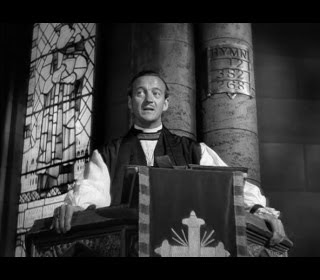
Of course, there is more to this movie than merely an inspiring character (which is easily enough to carry a movie on its own—see Jimmy Stewart's Harvey if you need some convincing). The greatest message of the movie arrives in its final scene, as David Niven's Bishop Henry delivers one of the most poignant, effective, and spot-on Christmas messages Hollywood has ever produced. Here it is, in its entirety:


Tonight I want to tell you the story of an empty stocking.


Once upon a midnight clear, there was a child's cry, a blazing star hung over a stable, and wise men came with birthday gifts. We haven't forgotten that night down the centuries. We celebrate it with stars on Christmas trees, with the sound of bells, and with gifts.

But especially with gifts. You give me a book, I give you a tie. Aunt Martha has always wanted an orange squeezer and Uncle Henry can do with a new pipe. We forget nobody, adult or child. All the stockings are filled—all, that is, except one. And we have even forgotten to hang it up. The stocking for the Child born in a manger. It's His birthday we're celebrating. Don't let us ever forget that.

Let us ask ourselves what He would wish for most. And then, let each put in his share: loving kindness, warm hearts, and a stretched-out hand of tolerance. All the shining gifts that make peace on earth.


What we see here is a call to action, in the greatest of spirits. It is a call to service, but not the kind of service we typically think of. The sermon does not explicitly tell us to go to Africa and feed the starving children (although many do, and render the world a great gift in doing so). It does not exhort us to go and build homes for disaster victims (although many do, and can joyfully make an irreplaceable difference in the life of a fellow human being in doing so). It does not command us to spend our every moment engaged in feeding the hungy at soup kitchens (although many do, and help provide a chance at success to countless souls in doing so). No, the sermon does not call us to anything that the world would call "great." It calls us to a different kind of service, a more fundamental one that can begin anywhere and continue into eternity—and, if put into practice, will change the world in a truer way than any work of human hands ever could.


This type of service begins in the heart, and consists of one simple step: Conduct yourself with love. Love for God, love for other people, and love for yourself. Mother Teresa summed it up quite well when she told us to Do small things with great love. If we conduct ourselves with love, then we will always produce good fruit in the world. Love the people you have contact with. Have faith that God made them and put them in your life for you to love them, as He Himself loves them. Love the places you frequent, the vehicle that transports you, the work that sustains your life. Love your church and your God, and don't ever forget to love yourself. If you find yourself looking in the mirror and finding that there isn't much to love, do two things:


1. Realize that as a creation of God, you are fundamentally worthy of love, no matter how bad a person you have been. St. Paul wasn't lying when he said that Nothing can separate us from the love of God. You deserve to be loved by yourself, because you are already loved by God—no matter what! Right the wrongs and move forward in confidence.


2. If there are flaws in your character that seem unlovable, change them! Resolve to change them, out of love for Him Who created you, out of love for those who must deal with your flaws, and out of love for you, who deserve to enjoy a higher, more successful existence. Choose to be dynamic.


"Conduct yourself with love." Of course, this is not a new message. Certainly it appears countless times in the New Testament. But seeing a movie like The Bishop's Wife is a great modern wrapping of this timeless message, a message that seems all too forgotten in the world.


This Christmas, and all the time, I commit myself to doing this kind of service as much as my fractured human awareness permits me—and I hope that you will do the same, dear reader.


I would like to invite you to join me in renewing a little Yuletide tradition that I previously kept in my personal journal, but sadly neglected to continue last year. The tradition, which I'm glad to have you aboard for, is that of writing and reading a prayer at Christmastime. Regardless of whether or not you are "a praying man," to quote George Bailey in It's A Wonderful Life (it's a wonderful movie), I invite you to read through this. If you believe in God, then you know that praying this will do good things for the world. If you don't believe, then what's the harm in saying a few words? It would mean a lot to me. Here, let's begin:


Dear Father in Heaven,


On behalf of humanity, thanks for the awesome Christmas present! You came to us as a man, entering this world by the same way that all of us enter, coming as a baby. In the beautiful birth of that baby, You were and are the greatest Christmas present of all. Help us to realize that. Help us to listen deeply to the carols that tell of your birth, and grant us insight into what your coming really means for all of us and for our salvation.


We pray that you will not let us forget the small changes of mind and heart and hand that can make the world's difference for the person next to us—the smiles on our lips, the warmth in our tone of voice, and the fire of love in our hearts. May Your spirit ignite and rekindle that fire in our hearts, and may we be open to this nourishing flow that connects our human hearts with Your sacred heart.


And may we never forget the sacrifices of those who make us happy at Christmas and throughout the year—sacrifices that imitate the ultimate sacrifice you made for us up on Calvary hill. That was the final act of the life that began on the first Christmas night. Let us not forget that, either.


But most of all let us not forget that the life that began on that first Christmas still continues to this day—and the jolliest Christmas spirit is merely a reflection of that original Gift, the Gift Who changed the world. Let our faith in You nurture a servant's heart in all of us, that we may serve the world each in our own way, and help our fellow humans to have a Merry Christmas and the Happiest of New Years!


We ask all of this in Your name, Jesus.


AMEN.


Merry Christmas, and here's to the best New Year yet!


With Christmas Love,

Joezilla