Showing posts with label movies. Show all posts

20130617

Man of Steel: For Little Boys and Theologians Only


If Michael Phillips’ review in the Chicago Tribune is any indication, it seems that critics (and perhaps moviegoers) have finally had it with absurdly over-the-top, literally earth-shattering special effects sequences in big-budget action films.  It is entirely okay, and indeed often preferable, to have a movie climax that does not involve the potential annihilation of the planet.  Perhaps moviegoers are finally realizing the boredom of sheer excess—when every movie plot threatens a major U.S. city with total destruction, it’s just about the same as if none of them did.  This is a conclusion the public has needed for quite a while (and it’s a horn I’ve been tooting for some time—see my review of last summer’s The Bourne Legacy).  In the wake of such special effects love feasts as the Transformers series—and amidst legitimately awesome blockbusters like The Avengers—America is in need of thoughtful, clever, yet simple films.  Fewer special effects, more snappy dialogue, and a focus on plot.

Yes, we have overdosed on special effects, and Man of Steel may have finally alerted folks to this grave fact.  I am relieved to see that there may be light at the end of this decade’s heretofore entirely computer-generated tunnel of explosions.  How ironic, then, that I found myself loving Man of Steel, and cannot bring myself to agree with the lukewarm or unfavorable reviews that some critics and viewers have afforded it.

There are two reasons for this.

First, the battles.  The battles in Man of Steel are completely over-the-top, exhibiting each and every symptom of dumb action movie excess, including but not limited to: extreme close-ups of hand-to-hand combat that obscure the events of the brawl and render it less exciting; unconvincing computer-generated body doubles engaging in unbelievable stunts that likewise diminish the excitement of the movie; an absurd scale that requires not just the combatants, but entire skyscrapers and city blocks to be brought down over the course of the fight; disconcerting collateral damage that calls to mind the presumably grisly fate of countless bystanders, who are totally glossed over in the movie’s narrative; and volume jacked up so high that one exits the theater both dizzy and wondering how to treat a perforated ear drum.

And yet, for all that, the battles are awesome.  They are everything I would hope for in a Superman battle.  Superman punches with marvelous strength; his enemy returns a blow of equal magnitude.  Superman grabs his foe, flies a mile into the air, and slams him back to earth—and leaving his mark in the form of a crater.  Watching the battles in Man of Steel, I was taken back to my childhood, which was filled with epic battles between Godzilla and King Kong, Spider-Man and Venom, and a host of other heroes and monsters who filled my toybox and my coolest daydreams.

I smirked as Superman flew General Zodd up into space, only to be smashed by his villainous foe into an orbiting satellite and thrown back into our atmosphere (both of them catch on fire as they hurtle back down to earth, and of course neither is affected negatively by this development).  Yet the smirk was not one of cynicism, but fraternal enjoyment; I knew that somewhere on the other end of this movie was someone who agreed with me that “it would be really cool if Superman grabbed him and flew up so high that he went into space, and started punching him while he was up there, and then he crashed into a satellite, and they both fell back down to earth and caught on fire…”  You get the picture.  And yes, that also goes for the absolutely awesome scene in which Superman tackles Zodd at lighting speed, rolls him through miles of dirt, punching him savagely all the while, and eventually launches him full speed into a truck filling up at a gas station.  This is in response to Zodd bullying Superman’s earthly Mom (while he’s punching Zodd, he yells, “YOU…THINK…YOU…CAN…THREATEN…MY…MOM!?!”).  For any boy who loves his own Mom, this is seriously fun to watch.

The battles are not perfect.  The effects sometimes look a little unrealistic.  It is unclear how exactly Superman wins the fight (because spoiler alert, he wins).  And they certainly display no sense of subtlety or restraint.  But sometimes we’re not in the mood for restraint.  And what better way to indulge such a mood than in a harmless and basically innocent couple of hours in a movie theater?  If you enjoyed making your action figures bash each other across the living room and get crushed by giant boulders (i.e. sofa cushions) when you were younger, you will definitely enjoy this movie.

On to the second reason I enjoyed Man of Steel: it got me thinking about spiritual things.  I am a Theology guy, and I always comb movies, books, and shows for religious, spiritual, and moral messages.  Whether good or bad, they’re always there.  Man of Steel continues the recent superhero movie trend of self-sacrifice and responsibility so wonderfully inaugurated in 2002’s Spider-Man and continued by later Marvel and Batman films.

However, there is something about this movie that goes much deeper than the others.  Man of Steel transcends mere virtue and, I contend, delves into specifically religious and Christian ideas.  Throughout the movie, Superman is presented as a sort of Christ-figure.  On the surface level: he’s 33 years old, he’s lived a life of relative obscurity leading up to his public career as a wonder-worker, his father is dead by the time he’s an adult and he is very close to his mother, and he is met with varying degrees of both admiration and suspicion by those who encounter him.

On a deeper level, we see Superman/Kal-El/Clark as a blend of humanity and superhumanity; we see him interact with and master forces the like of which any number of humans couldn’t dream of taking on; we see him courted by evil and tempted to abuse his power by prideful superhumans who consider humanity an inferior creation; we see the hope of an entire people resting on his shoulders; we see him engage in a struggle that literally no one else could begin to take up; we see him banish evil with an act of total self-sacrifice.

I will dwell on only one scene to illustrate this point.  When Superman attacks the terraforming machine in the Indian Ocean, he is weakened by the atmospheric changes surrounding the contraption.  After fighting off a set of serpentine metal tendrils in spite of his weakened state, he is forced underneath the full blast of the machine’s world-destroying might.  We see him engulfed in blue energy emanating from the machine, apparently being pushed to the limits of his resilience and strength.  It seems that he might not survive as he scrunches up his face in pain and yells in agony.  Yet just when it seems that he won’t pull through, he launches up against this stream of energy and slices through the machine’s innards in a stunning upward flight.

Perhaps it seems absurd, but this scene got me thinking about Jesus’ suffering and crucifixion.  What I saw in the movie—Superman withstanding a torrent of lethal otherworldly energy and emerging the victor—made me look at Jesus’ act of sacrifice in a new way.  Specifically, it focused my attention on the spiritual aspect of the Passion.  Of course we often consider, especially before Easter, the extreme physical suffering Jesus went through for our sake.  But we must remember that we also believe that, in taking the burden of the cross on his shoulders, Jesus was taking the weight of humanity’s guilt upon himself.  During those awful hours of torture and death, Jesus took up the unfathomable mass of man’s evil, carried it with him along the way to Calvary, and ultimately destroyed every ounce of it.  There was more negative energy—more evil, pain, guilt, shame, regret, horror, hatred, disgust, and misery—concentrated on Jesus Christ at that time than on any other person in history before or since, or ever.  How amazing is that, that he did that for us?  The blue energy that almost killed Superman in this movie is, to me, another way of expressing the spiritual aspect of Jesus’ suffering.
 

Now I should already know the amazing nature of Jesus’ sacrifice, and in some sense I do.  But seeing this computer-generated spectacle on screen today made me realize the magnitude of Christ’s spiritual agony as he faced off against the worst stuff that evil could throw at him.  In taking our guilt upon himself, Christ did the most amazing, heroic, and wonderful thing anyone has ever done or will do.

I may not be making myself clear.  We illustrate and meditate on depictions of the physical suffering of our Savior (and this is good and important).  But how often do we reflect on the spiritual aspect?  How could it have felt to carry the punishment incurred by an entire race of beings on a single man's shoulders?  It is a fearsome thing to consider.  And we just don't think about it when we see a picture of the crucifixion, because it's not something that comes through in a picture, or even in the physical event itself.  Onlookers could not see the burden of sin Jesus took up on his way to Golgotha.  It was and is a spiritual reality, accessed and understood only through faith.  We believe it, but we could never see it with our eyes.

Man of Steel is certainly not a straight allegory of Jesus.  If it was intended to be, it’s a train wreck.  But I don’t think that was the filmmaker’s intention.  Instead, I think the idea here was to illustrate certain Christian ideas and images in interesting ways.  In that sense, the movie is a complete success.

So there you have it: Man of Steel, a film for little boys and theologians.  Go see it.  I think you might enjoy it.

20120819

Simply Entertaining

Sometimes it’s good to keep it simple. In the days of jaw-dropping, mega-budget, knock-your-socks-off, blow-you-away, over-hyphenate-your-phrases blockbusters like The Avengers and The Dark Knight Rises (and in light of their impressive success at the box office), I was starting to wonder if every action film would now be an attempt to top those which preceded it (a feat that Avengers essentially accomplished, and Rises definitely tried to accomplish). After all, this trend had been building for the better part of a decade—look no further than the climax of Pirates of the Caribbean 3, which featured Jack Sparrow dueling a man with a computer-animated octopus head on the mast of a ship that is simultaneously caught in a whirlpool and being attacked by both another ship and a mythical sea beast. And, oh yeah, it’s raining. Is that a run-on sentence? Yes, but only because it describes a run-on scene.

The Avengers would seem the epitome of such excessive filmmaking, but it manages to dodge this bullet (so to speak) with an ensemble of likable characters, the wittiest script since True Grit, and, amidst its super-sized muscles and explosions, a clear purpose and objective in every scene. The viewer’s questions are rarely left unanswered, and every piece of action serves some purpose in telling the story. You can call The Avengers excessive, if you want. But it’s excessive like a good buffet, which is to say extremely satisfying and quite fulfilling every now and then.

But not every movie can be The Avengers. And as Dark Knight Rises demonstrated, in the arena of summer blockbusters, there’s only room for one impending nuclear threat. If audiences are routinely presented with nuclear bombs aimed at Manhattan, the whole prospect will just become sort of blasé. And that, we can agree, is a bad thing—both for movies and national security.

But the fact is, not every action movie can top its predecessors. When makers of such films attempt to “keep up with the Joneses,” the result is a very stale crop of movies. And is there anything worse than being bored by an action movie?

In the aftermath of Avengers and Rises, then, it would seem that the ironic goal of the next big action movie would have to be minimalism. Enter The Bourne Legacy, starring Jeremy Renner (a.k.a. Hawkeye from The Avengers). Legacy is just what the PG-13 action genre needed right now—a simple and direct story that is modest in plot, scale, and action.
The story of Bourne Legacy is very simple: the government is trying to track Renner down, so he has to escape. Along for the ride is the beautiful and apparently ageless Rachel Weisz, who spends 90% of the film gaping like a deer in headlights—but in a very appealing way.
The plot also seems less serious, less seething with anti-waterboarding rage, than its predecessors. Of course, the sinister government officials (a trademark of the Bourne series) are still there, gravely staring at giant video-walls as they always do. But the whole affair seems less like it’s trying to tell us something serious, and more like it’s just trying to give us a fun time. And generally, that’s what we want in a movie.

The scale of Bourne Legacy is simple, as well. Going against the globe-trotting grain of recent films (such as Mission: Impossible 4, another excellent action film co-starring Renner…hmm, noticing a pattern here?), Legacy features only one plane ride. The bulk of the action takes place in Manila, a suitably dusty urban setting for the rooftop gymnastics, fast-paced car-chases, and perfectly-calculated arrivals that are another trademark of the Bourne movies. But the setting is relatively understated.

Most important of all, though, the action is simple. Basically, this movie is the anti-Pirates 3. Its climax is a motorcycle chase. No nukes aimed at the Big Apple. No world-devouring alien approaching from a black hole. Just a bad guy, a good guy, and a pretty woman, weaving through crowded traffic on cycles. It’s a scene that could have appeared on the big screen fifty years ago, and it’s just as effective now as it was then.
It’s nice to see that we haven’t completely lost our ability to enjoy the simple things in life.

Happily,
Joezilla

P.S.: How wonderful it is to see a chaste romance in a Hollywood movie! Once again, Bourne Legacy manages to deliver the goods without overdoing it. Let’s hope this is a trend that catches on. Keep praying, though… ;)

20120508

Hero


Humanity has always been captivated by the idea of the hero.  We have never stopped telling stories about heroes.  Why is that?  I think it is because we thrive on examples.  We can do a job much more effectively if we see someone else do it first.  In the same way, we can be better people if we see someone else model the right attitudes and behaviors.  So we look to heroes to give us that inspiration, that push in the right direction.  If our desire to be a hero is great enough, we start to live like a hero.  And living like a hero is the only way to become a hero.


Lately the movie Captain America has been on my mind.  In a strange way, I was pulled into the heartwarming but heart-wrenching story of the Cap.  But more than that, I was drawn to the character as he is portrayed in the film, as well as its mind-blowingly awesome sequel, The Avengers.


In Captain America you have the quintessential fish out of water.  Plunged into science-defying (but plot-satisfying) sleep for 70 years under polar icebergs, Captain America is thawed out to a rude awakening just in time to answer another call of duty: the Earth and its inhabitants are now threatened by an enemy both supernatural and extraterrestrial.  What does Cap do?  Does he mourn the lost promise of love he left behind in 1943?  Does he wallow in the unbelievable changes the world has gone through since his era?  Does he change who he is to blend in with his surroundings?


Well, yes to all of those, for a time.  He is human.  He mourns.  He wallows.  He even responds uncertainly to the pressure of his new surroundings.  But soon enough, when the need arises, Cap gets out of himself, suits up for action, and proceeds to risk life and limb for what he believes in, which is protecting the innocent, fighting injustice, and promoting the ideals of our free country.

God has used this fictional character to turn my heart toward an important truth:  Heroism is about doing the best thing possible whenever you have an opportunity.  But we also learn that a hero quickly becomes a loser (and sometimes an instrument of evil) when he starts to focus on himself.  What is inspiring about Captain America is that he never does this.  It's always about the mission, the objective, the well-being of others.  Self-sacrifice is not a stumbling block, not even the subject of a moment's hesitation.  Giving it all he's got is standard operating procedure.

In many ways, he reminds me of the very real Theodore Roosevelt, who said:

The true Christian is the true citizen, lofty of purpose, resolute in endeavor, ready for a hero’s deeds, but never looking down on his task because it is cast in the day of small things; scornful of baseness, awake to his own duties as well as to his rights, following the higher law with reverence, and in this world doing all that in him lies, so that when death comes he may feel that mankind is in some degree better because he has lived.

Was Theodore Roosevelt the real-life version of Captain America?  In his youth, he was a tiny whelp of a child, weakened by asthma.  Through sheer determination and unrelenting discipline, he conquered his weakness and grew into a brawny barrel of a man.  More importantly, he grew on the inside as well.  Roosevelt became one of the most dynamic, confident, and inspiring leaders this country has ever seen.  He represented our country to the world as a place of freedom and opportunity, looking out for the poor and downtrodden workers while refusing to dump all the country's problems on the rich.  He paraded a brand-new, state-of-the-art fleet of battleships around the world, painted stark white--a stunningly eloquent symbol of America's commitment to peace and its power to defend it against bullies.  Was Theodore Roosevelt Captain America?  I'm convinced.

Heroes like these, both fictional and real-life, point to the person I would call the quintessential human hero of our history: the Virgin Mary.  Catholicism teaches that Mary was conceived without sin, and lived a sinless life.  So great was her virtue that at the time of what would have been her earthly death, she was simply "assumed" bodily into Heaven.  No Purgatory, no penitence, no perfecting necessary.  She was simply the ideal that all the rest of us poor human saps should live up to.

Mary comes onto the scene in the Bible with such an inspiring message.  On her lips is the motto of all true heroes:  "May it be done to me according to your word." (Luke 1:38)  This, ultimately, is what life is all about—discerning the will of God, our marching orders for life, and answering that call of duty.  Each day when we get up, we must spring into action, unhampered by negative pressures from both without and within, never losing sight of that purpose.  At the end of the day, if we have looked up to God and said "May it be done to me according to your word," and really offered our day in accordance with His will, then we are heroes.  And, ultimately, we are happy.

So I'd like to thank God for both Theodore Roosevelt, and all the people who contributed to the Captain America film.  Both of these rather macho figures ironically but understandably pushed me toward a greater devotion to the Blessed Virgin Mary, and a more personal understanding of why she is given such great honor in our tradition.


I could talk about heroes all day.  But then I'd have no time to actually try to be one.  Perhaps you, too, need to connect with Home Base and figure out what exactly you're supposed to be doing.  I hope your communication is successful and clear.  See you in the trenches.

Hail Mary!
Joezilla

20101224

Christmas, The Bishop's Wife, and True Service


Hello there, and Merrrrrrry Christmas!

o<(:})>

In case you were wondering, dear reader (if, in fact, there is any dear reader out there to be wondering), the seemingly unintelligible jumble of symbols above is my patented new Santa Smiley (all rights reserved, of course!). If you're puzzled by this moniker, look at it sideways and everything will make sense. Ho-ho-ho!

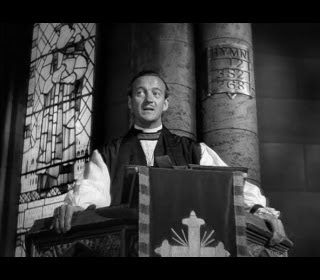
Today I just watched the wonderful Christmas film The Bishop's Wife, starring Cary Grant, David Niven, and Loretta Young. It's a wonderful movie that could be best characterized with a single word: charm. The actors are charmingly entertaining—funny when they're supposed to be funny, touching when they're supposed to be touching, and at all times quite convincing in the clever little plot the movie relates.

It is a great film from a great era of film-making, but this is not what puts it over the top. On the contrary, the greatest charm of this movie comes in its superb and enlivening message.

I firmly contend that the best entertainment is the kind that makes us want to be better people. The best book is the book that, upon its finishing, causes the reader to throw it to the ground, jump up in a fit of ecstasy, and embark on some great adventure that will somehow better the world. The best song is that which grants its listeners a supernatural sort of energy upon hearing it or even thinking of it, the kind of song that galvanizes the dazed denizens of the doldrums (we've all been there) and renders them ready for righteous battle on some unknown front in the war of their own life. And the best movie is the kind that gives us a larger view of life—one that, by means of its broadness and great perspective, provides us with creative new solutions to old problems...as well as the hope and inspiration to carry out such ambitious endeavors.

The Bishop's Wife is just such a movie. Its headlining actor, Cary Grant, plays the role of the angel Dudley (what a great name for an angel!) with a paradoxical mix of vivacity and restraint—two typically contrasting traits effectively united by a peaceful air of sheer goodness—showing us a character who has an overwhelmingly positive effect on everyone he encounters. We can't help but be won over by Dudley as we see him in action, spreading faith and honesty with every word he utters and every move he makes. And there's a part of each one of us that longs to be like him—to be connected to God with such a firm bond as to walk each day with supreme confidence as we do good work.

Of course, there is more to this movie than merely an inspiring character (which is easily enough to carry a movie on its own—see Jimmy Stewart's Harvey if you need some convincing). The greatest message of the movie arrives in its final scene, as David Niven's Bishop Henry delivers one of the most poignant, effective, and spot-on Christmas messages Hollywood has ever produced. Here it is, in its entirety:


Tonight I want to tell you the story of an empty stocking.


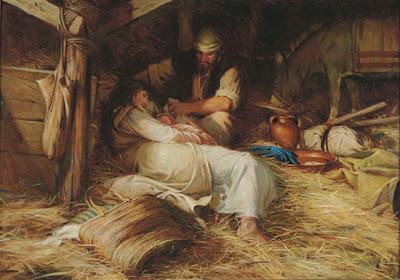
Once upon a midnight clear, there was a child's cry, a blazing star hung over a stable, and wise men came with birthday gifts. We haven't forgotten that night down the centuries. We celebrate it with stars on Christmas trees, with the sound of bells, and with gifts.

But especially with gifts. You give me a book, I give you a tie. Aunt Martha has always wanted an orange squeezer and Uncle Henry can do with a new pipe. We forget nobody, adult or child. All the stockings are filled—all, that is, except one. And we have even forgotten to hang it up. The stocking for the Child born in a manger. It's His birthday we're celebrating. Don't let us ever forget that.

Let us ask ourselves what He would wish for most. And then, let each put in his share: loving kindness, warm hearts, and a stretched-out hand of tolerance. All the shining gifts that make peace on earth.


What we see here is a call to action, in the greatest of spirits. It is a call to service, but not the kind of service we typically think of. The sermon does not explicitly tell us to go to Africa and feed the starving children (although many do, and render the world a great gift in doing so). It does not exhort us to go and build homes for disaster victims (although many do, and can joyfully make an irreplaceable difference in the life of a fellow human being in doing so). It does not command us to spend our every moment engaged in feeding the hungy at soup kitchens (although many do, and help provide a chance at success to countless souls in doing so). No, the sermon does not call us to anything that the world would call "great." It calls us to a different kind of service, a more fundamental one that can begin anywhere and continue into eternity—and, if put into practice, will change the world in a truer way than any work of human hands ever could.


This type of service begins in the heart, and consists of one simple step: Conduct yourself with love. Love for God, love for other people, and love for yourself. Mother Teresa summed it up quite well when she told us to Do small things with great love. If we conduct ourselves with love, then we will always produce good fruit in the world. Love the people you have contact with. Have faith that God made them and put them in your life for you to love them, as He Himself loves them. Love the places you frequent, the vehicle that transports you, the work that sustains your life. Love your church and your God, and don't ever forget to love yourself. If you find yourself looking in the mirror and finding that there isn't much to love, do two things:


1. Realize that as a creation of God, you are fundamentally worthy of love, no matter how bad a person you have been. St. Paul wasn't lying when he said that Nothing can separate us from the love of God. You deserve to be loved by yourself, because you are already loved by God—no matter what! Right the wrongs and move forward in confidence.


2. If there are flaws in your character that seem unlovable, change them! Resolve to change them, out of love for Him Who created you, out of love for those who must deal with your flaws, and out of love for you, who deserve to enjoy a higher, more successful existence. Choose to be dynamic.


"Conduct yourself with love." Of course, this is not a new message. Certainly it appears countless times in the New Testament. But seeing a movie like The Bishop's Wife is a great modern wrapping of this timeless message, a message that seems all too forgotten in the world.


This Christmas, and all the time, I commit myself to doing this kind of service as much as my fractured human awareness permits me—and I hope that you will do the same, dear reader.


I would like to invite you to join me in renewing a little Yuletide tradition that I previously kept in my personal journal, but sadly neglected to continue last year. The tradition, which I'm glad to have you aboard for, is that of writing and reading a prayer at Christmastime. Regardless of whether or not you are "a praying man," to quote George Bailey in It's A Wonderful Life (it's a wonderful movie), I invite you to read through this. If you believe in God, then you know that praying this will do good things for the world. If you don't believe, then what's the harm in saying a few words? It would mean a lot to me. Here, let's begin:


Dear Father in Heaven,


On behalf of humanity, thanks for the awesome Christmas present! You came to us as a man, entering this world by the same way that all of us enter, coming as a baby. In the beautiful birth of that baby, You were and are the greatest Christmas present of all. Help us to realize that. Help us to listen deeply to the carols that tell of your birth, and grant us insight into what your coming really means for all of us and for our salvation.


We pray that you will not let us forget the small changes of mind and heart and hand that can make the world's difference for the person next to us—the smiles on our lips, the warmth in our tone of voice, and the fire of love in our hearts. May Your spirit ignite and rekindle that fire in our hearts, and may we be open to this nourishing flow that connects our human hearts with Your sacred heart.


And may we never forget the sacrifices of those who make us happy at Christmas and throughout the year—sacrifices that imitate the ultimate sacrifice you made for us up on Calvary hill. That was the final act of the life that began on the first Christmas night. Let us not forget that, either.


But most of all let us not forget that the life that began on that first Christmas still continues to this day—and the jolliest Christmas spirit is merely a reflection of that original Gift, the Gift Who changed the world. Let our faith in You nurture a servant's heart in all of us, that we may serve the world each in our own way, and help our fellow humans to have a Merry Christmas and the Happiest of New Years!


We ask all of this in Your name, Jesus.


AMEN.


Merry Christmas, and here's to the best New Year yet!


With Christmas Love,

Joezilla

20100205

Today is Tomorrow

“It’s gonna be cold, it’s gonna be gray, and it’s gonna last you for the rest of your life.” So testifies Phil Conners, world-class meteriologist and full-time jerk, in one of his lowest moments in the wonderful movie Groundhog Day. Whether or not we agree with Phil’s prediction tells us a lot about how we are currently seeing the world.

Phil’s is a unique tale; he goes to wintry Punxatawney, Pennsylvania to cover the annual Groundhog Day festivities, dutifully does his drudgery, then goes to sleep. He wakes up the next morning to a cold Punxatawney morning…a cold and familiar Punxatawney morning. Yes, as you probably already know (unless you have not seen the film, in which case you are seriously missing out), Phil is forced by the powers-that-be (in this case, it’s writer-director Harold Ramis) to relive the same day, over, and over, and over again.

How long is Phil trapped in this temporal wasteland? Months, maybe. Probably years. He’s there long enough to learn the quirky backgrounds of almost every citizen in Punxatawney, long enough to become a semi-pro piano-player, and long enough to become a trilingual aficionado of classic literature. And oh yeah, long enough to devote himself to a noble purpose—in fact, the noblest purpose anyone can dedicate himself to: self-improvement for the sake of others. But before he does any of that, he first attempts to wring out every inch of “fun” that he can from Punxatawney. It feels great at first, but soon the superabundance of, well, pretty much anything he wants, reveals the true emptiness of temporal pleasures.

The turning point comes when Phil talks to his pretty (and practically perfect in every way) producer, Rita. Convinced of his predicament, Rita offers this bit of advice: “Perhaps it’s not a curse. Maybe it just depends on how you look at it.” Phil promptly wakes up the next day and brings his co-workers coffee and pastries to enjoy amidst the bustle of their morning labor. In doing so, he begins the long and determined climb out of the hole he’s dug for himself, and at this point demonstrates a fundamental and potentially life-changing truth: kindness is a universal language. People worry too much about social niceties and clever turns of phrase, but Phil shows that an action fashioned from consideration and performed with kindness needs no fancy social wrapping. Be good, and everything else falls into place.

“As time goes by,” as they say, Phil builds himself into a true man—good-hearted, disciplined, and well-rounded (though, importantly, he remains as funny as ever). He takes up piano. He reads. He devotes himself, wholeheartedly it would seem, to serving others. Not a bad idea, Phil! It culminates in an epic day that seems to contain everything—music, dancing, snow-sculptures, a couple of saved lives…

Phil wakes up the next morning, and things are different. Can you imagine what it might feel like to live the same day over and over again for years, and then to wake up to a new one? Phil definitely shares the epithet of Dr. Manette in A Tale of Two Cities: RECALLED TO LIFE!

It should give us pause to realize that the universe, blessedly, doesn’t actually play tricks like that. We will go to sleep tonight, and we will wake up tomorrow, never to set foot on this date again. Perhaps that makes us want to seize this day, and that’s great. But more than that, I think it should make us appreciate the fact of tomorrow.

Think about it. You will wake up tomorrow, and there will be a whole new day ahead of you. What’s best, you will be able to act in that day, knowing that your good actions will have lasting consequences. Do you realize what a difference you can make in this world? Such great potential streams out of your every step; so be happy, wherever you are! As Phil says, incredulous, in the movie’s cheery final moments, “Today is tomorrow. It happened.” We all might benefit from saying that when we wake up to bright skies, gray or otherwise, in the tomorrow that never forgets to come. Today is tomorrow! Remember that!


And Winter slumbering in the open air,
Wears on his smiling face a dream of Spring!

(Samuel Taylor Coleridge)

Happy Groundhog Day!

Peacefully,
Joezilla

20090907

The Entry Where I Spoil Matchstick Men (I’m serious)


I am currently experiencing one of those splendid and rarefied spans of moments of complete confidence and sheer inspiration. If I may borrow one of J.K. Rowling’s best ideas without glorifying her too much, I have just drunk a bottle of Felix Felicis. I see the path of life drawn out before me; and though the route is as unclear as ever, I do possess the two real essentials to a successful journey; the first is a goal, which I have had for years, thanks to the Catholic religion I was born into and have embraced as the Truth. The second essential, bestowed upon me yet again by divine inspiration, is the more elusive, as it involves more than just a willful leap of faith and devotion. The second is the modus operandi, the method of working—which, God bless it, comes out from behind the clouds of uncertainty every now and then to shine its light upon us.

I just finished watching the movie Matchstick Men. It tells a tale of loss, illusion, and redemption, and reminds us that if we keep our noses clean (morally as well as legally), we never have to worry about much. It tells us the tale of an expert of deception who has nonetheless kept a portion of his soiled soul spotless, a man who receives a life-shattering dose of his own medicine when he is taken in by several who do not share his scrappy scruples, and thus have a slight edge in the crafty craft of con-artistry. In the end, Roy’s decency is what destroys him, or at least what he assumed was “him.” What we find out, in the crucial moments at his ex-wife’s door, when the depth of the deception finally hits home, is that—although his life lies in a shambles, with almost no money, no worldly credentials, and no real family—he is just fine. Indeed, as Roy himself iterates with a fledgling but hopeful confidence, “everything’s all right.” Out of the ashes of the two-bit Phoenix that was Roy’s former life as a con-man, we see the real Roy rise up; the Roy who forced himself to rationalize his spoils as “given, not taken,” the Roy who “never used violence,” the Roy who reached out to the nice checkout lady at the supermarket, like a withered plant inclining toward cracks of light through closed rafters. That is what carried Roy through to the end of his sinful life, and that, we finally see, is what carries him into the bright future. In the epilogue scene at the carpet store where Roy has built a clean livelihood, his brief meeting and parting with his “daughter” shows us that he has overcome any ill will which he might have held against his looters. We see a man who is free to fly because, in the words of G.K. Chesterton, like the angels he “can take himself lightly.” Matchstick Men reminds us that nice guys do not finish last—they may wind up in last place, but they always have time to work out of the hole and regain the good they were made for.

I suppose this movie just reminded me to be confident. After watching it, I realize I am ready to begin the next schoolyear. I feel like I can do exactly what I’m supposed to do. I’m excited to face opportunities to stand up for what I believe in, to proudly be the person God wants me to be; to be open to new possibilities, but also open to the mere continuation of old realities.

“To be content with where I am,
Getting where I need to be,
And moving past the past where I have failed.”


I am excited to exercise the grace which God has blessed me with this summer, to let the spiritual discoveries of these months germinate and flower into strong trees of good work and wholesome habits in my sojourns with the wider world. I am looking forward to the future months so intensely, and that is why my highest hopes are fulfilled by actually being plopped right here, in this moment, several weeks before all those busy days begin. One might say it is the final exam of summer school. Conventional wisdom, and Catholic theology, say that the way we finish the journey is the strongest indication of how we conducted it. Finishing strong is the only true reflection of a strong performance.

Did I learn anything this summer? Ha! How could I not have? I acted like an idiot enough (and felt bad about it) to learn quite a bit about compassion, authenticity, and honesty. At the same time, I also worked hard to build myself up, and thus learned the blessing and strength of good habits (and the easy poison of bad ones). I felt the push of a noble purpose and a steamrolling confidence drawn solely from the divine team I’m playing for.

I guess what I am trying to say is that these final weeks are the final test of this current crop of moments, and a sort of runway into the year. If I run this final stretch well, I will be ready to run the whole year. If I stumble, I may not get back up until next June. Spiritually speaking, that’s a long time down, way longer than I can afford.

So here I leave you, as always, at a crossroads; my decisions in the next few weeks will decide my ultimate destiny, of that I am sure. But then again, is that ever not the case?

Signing off with love and prayers for you,
Joezilla

20090812

Citizen Mundane

This is not a case of The Emperor’s New Clothes. What I mean to say is that Citizen Kane is a good movie--artistically speaking, a great movie. To anyone with a strong knowledge of the history and craft of filmmaking, perhaps it could understandably be the greatest movie ever made or released. But to an Average Joe like me (and you, if I may assume that someone reads this), it is not a masterpiece. It left me feeling unresolved, questioning, curious. These are not bad feelings to have after a movie (and I have reason to believe they are exactly the feelings Orson Welles wished to evoke in audiences), but they are not the feelings left in the wake of the best movies. The best movies leave viewers feeling inspired--they show examples of heroism, exciting and empowering. Citizen Kane does not show us heroism. It shows us snippets of the life story of a very warped, very rich man--a man warped by his riches. We see glimpses of people who knew the man, but we don’t see much to admire.
The film’s strongest proponents, no doubt, would point to its open-endedness as one of its great assets. What is the significance of this or that object, they might ask. Anyone can guess at the million meanings of every scene, every line, every camera angle; the film's enduring strength, then, lies in the amount of thought it provokes. Indeed, Citizen Kane is a puzzle, if I may borrow a symbol from the movie itself, a puzzle purposely left unfinished. Discussions could abound after a group viewing, and many would sound like high-school literature class, with various expositions on the meaning of a chair or the symbolism of someone's hat. Such celluloid enigmas can lead to entertaining and worthwhile late-night discussions in the living room. Lack of resolution, then, is not Kane's chief weakness, and actually lends it much of its luster. Its true problem is the decided lack of a compelling message. For the sake of those who have not seen Citizen Kane, I will not state this message here (assuming, of course, that some constituent of this blog’s questionably-existent audience has not seen it). This omission is not a problem, though, because the final lines and scenes of the film broadcast the message quite loud and clear.

The point is, this message is the culmination of the film, the main idea which all of Welles’ technical and artistic effort has strained (quite successfully) to convey. Unfortunately, the message is nothing extraordinary. It’s the sort of conclusion that one might arrive at after fifteen minutes of quiet contemplation on a summer evening. More than anything else, it is an observation, and a prosaic one at that. It’s as if someone were to pour a mountain of money into an extensive advertising campaign in order to broadcast to the world the slogan “When I stub my toe, sometimes the nail gets broken.” Few would deny it. It would not set off philosophical debates about the nature of podiatric injuries and pain perception. But many would (I hope) wonder a simple question: Why not say something deeper?
Citizen Kane is for cinema what Charlie Parker is for jazz music--justly-admired for technical mastery, somewhat lacking in a worthwhile message, and nearly-worshipped by aficionados, a reverence which has seeped into the culture at large.

20090725

Best Western (not a movie review!)

El Dorado is one of the best westerns there is. I like westerns. I like them because they teach me about life and how to live it. Here is how they do it.

First off, westerns tell stories of good and evil. They are complex tales of a simple conflict—just like life on this planet. No western is ever simple. In fact, the best ones place their heroes in unthinkably harrowing physical and moral dilemmas, often pitting survival against a principle. If you were sheriff of a fledgling western town, the one everyone looked to for protection, would you risk your life to fight a gang of outlaws for the sake of the town? What if your family’s lives were at stake? What if you could pay the outlaws money to go on to the next town? Would you do it? Here is what is great about westerns—they not only show us conflict between good and evil, but they show us what heroes do when placed in those conflicts. They show us the true courage, the selfless sort of bravery that risks life and limb to protect men and morals alike. This is a state of mind that is sorely missing in today’s society, and I sometimes fear we are losing our ability to even recognize it when we see it.

That is one reason westerns are great—they show us great evil vanquished by determined heroes in emotionally-charged settings. They call us to be heroes.
Secondly, westerns often demonstrate another often neglected value, that of common sense. How does John Wayne know that there are gunmen hiding outside the saloon? It’s not that unrealistic; he has experienced similar situations and observed carefully, and he has the presence of mind to apply those lessons to his current situation. If only we could be as on the ball as John Wayne’s characters are! How great we would be, how effective our lives would become, if we would only remind ourselves more often of the great truth—if we don’t act on what we learn, the knowledge does us no good at all.

John Wayne’s seemingly invincible characters preserve their lives by yet another valid real-world conviction—it is entirely okay, and sometimes praiseworthy, to not trust someone at all. Some people cannot be trusted; to trust such no-accounts, particularly with one’s or another’s life, contradicts Christ’s command in Matthew 7: "Do not give what is holy to dogs, or throw your pearls before swine, lest they trample them underfoot, and turn and tear you to pieces.”
To continue this digressive focus on John Wayne, his characters are never ashamed of themselves. This unconquerable confidence may be aided by the Duke’s imposing 6’4½” stature, but ladies and gents of all shapes and sizes have something to learn from him. The size of the dog in the fight, as they say, is not nearly as important as the size of the fight in the dog. Such a maxim ought to remind us that Wayne’s stature was largely (no pun intended) irrelevant to his imposing presence. After all, a 7 foot weenie will not make as big a splash as a 5 foot dynamo. The frame of the physical puppet which we command is only as good as the artist pulling the strings.

But back to the matter at hand, Wayne never feels shame. Why is this? Well, I see two reasons. First, he is confident, in the most admirable and exemplary way—he knows what’s right, and he stands for it, unwaveringly. Secondly, he does all the right things. In short, he has the right to be confident!
On to our final point—westerns, like life, find their biggest turning points in split-second decisions and acts of quick thinking. In any good western, the hero will eventually be called upon to make a huge decision in mere seconds, perhaps one solitary second. How can someone make the right choice when put on the spot? For someone who fails such a fast-paced test, could we not give them the benefit of the doubt, could we not assume that they would take the right action, if only given more time to think? Whether or not we could be so generous matters not at this moment—what matters is that life rarely offers us such drawn-out dilemmas!

Decisions of destiny are made on the spot, under pressure. In order to make them well, we need to train ourselves to have presence of mind, just like John Wayne and all the other good cowboys do. Theodore Roosevelt, that great spirit who once lived a true cowboy’s life in the real West, when it was actually Wild, wisely said that “In any moment of decision the best thing you can do is the right thing, the next best thing is the wrong thing, and the worst thing you can do is nothing.” Presence of mind and right thinking under pressure are key to a good life. Westerns cannot teach us this—the practice courts of everyday life are far better suited to this than any feature film—but they can inspire us to practice in everyday life. And perhaps, with regular inspiration and even more regular practice, we will join the ranks of those great spirits who, in Roosevelt’s words, can “quell the storm and ride the thunder.”