Isn't it amazing how fickle human emotions are? Although I'm sure we could all notice examples of this fact in other people's behavior, we need look no further than ourselves. How many times can we remember being on top of the world for a day or two, and then suddenly falling off the wagon just as quickly as we realized we were on it?
It seems that this is the general way of human nature, unless one is depressed (in which case you're pretty much always off the wagon) or enlightened (in which case you've got a ticket to ride the wagon indefinitely). Since most would agree that being on the wagon is more enjoyable than being off of it, I would like to offer a choice suggestion for getting back on if you find yourself having fallen off.
G.K. Chesterton once said that "Angels can fly because they can take themselves lightly." He's so right—those angelic moments in our life, when we feel about ready to fly on up to Heaven and leave our business unfinished down here, those are the times when we take ourselves lightly, and what wonderful times they are! We don't attach such heavy values to the things that happen to us, and even, I daresay, the things we do. We shun the force of our emotions, which tell us to worry about things, to dwell on things, to ruminate until our minds are burned out and our dispositions are rotten.
See how self-destructive it can be to listen only to emotions? When we let our emotions control our thoughts, it becomes impossible to think for ourselves. We are constantly influenced by our anger and our desire, and there's no chance for compassion to get through. Emotions are essentially self-centered phenomena—and if we let them drive, we'll get nowhere but nowhere in no time. We should not deny our emotions; but neither should we allow them to control our course.
I'm not saying that we should abdicate our responsibilities. On the contrary, when we take the focus off of ourselves by lowering the volume on our emotions, we begin to "take ourselves lightly" again—and, in turn, we become infinitely more effective in our respective missions.
So if you're feeling blue, perhaps you need a perspective shift. I suggest listening to Relient K's "High of 75," which inspired me to write this little bit. After listening to that song, take a little time to be "thankful for being alive," and perhaps your eyes will open a little wider, and you'll discover that the sun is out there, after all.
See ya!
Joezilla
20081110

20081012
The Amazing Everyman

He was born just like any other child, but after reaching adulthood, he grew and gained extraordinary abilities, towering over his former self. He can move with surprising speed and agility for a being so large. Further, his strength is great enough to lift heavy objects that many are unable to budge. For short periods of time, he can energize his system to allow himself heightened speed, strength, and reflexes, albeit with a short period of recovery afterward. His mind’s capacity and capability have increased exponentially since childhood, and he is now able to commit substantial chunks of information to memory and recall them, verbatim, at will. Every time he repeats an action, he becomes more proficient at it, resulting in potential perfection with practice. His only weakness is that he is not invulnerable, but his other abilities render this weakness moot in all but the most harrowing of circumstances.
He is the average grown man, and he vastly discounts his physical capabilities.
This is one reason why we love superhero movies. Every good superhero origin story has a scene where the hero first tests out his powers, and we always marvel at the seemingly limitless potential of our hero’s newfound abilities. Tobey Maguire’s Peter Parker hoots with joy as he leaps and bounds across the rooftops of New York, pushing his abilities to their limit—and realizing there may not be one. Robert Downey Jr.’s Tony Stark takes his newly-built Iron Man suit for a late-night spin through the skies and hits supersonic speeds without breaking a sweat. Despite a few close calls, he demonstrates the amazing potential of his new technology, and leaves us wondering if anything on the planet would be capable of taking him down.
The point here is that these scenes remind us of what it feels like to run through a field at full speed, or to swing a baseball bat with all our might—and see the ball go sailing toward the horizon. We ourselves possess superhuman powers, in a sense—can you remember marveling at your Dad’s seemingly limitless strength (he could open soda bottles with his bare hands!), and wondering how grown-ups could be so tall? Now you are that strong, you are that tall. Isn’t that awesome? We are all superheroes, in a sense, traversing our own perilous journeys, discovering our extraordinary powers, fighting our harrowing battles, nursing our weaknesses, and protecting whatever it is we hold closest to our hearts.
So go and do your duty, and remember—“With great power comes great responsibility.” Thanks, Uncle Ben!
20081009
A Random Idea That Awkwardly Popped Into My Head
Among the annals of recent linguistic trends, two of the most emphatically sudden additions to the American vocabulary are the popular usage of "random" and "awkward." Unless my social barometer is completely whacky, "random" describes unexpectedly felicitous events, as well as strange or unsolicited remarks or actions that have no rational precursor in a given interaction.
If you stopped reading that midway through, I don't blame you. I should be saving that kind of inflated verbiage for where I really need it, which is to say in academic papers. I don't know how much of it I have in me. Let's move on to the second word, which is the one I wish to focus on here.
"Awkward," like "random," possessed a clear and common definition before its recent induction into the cult of popular slang. The new definition now calls up negative, somewhat shameful connotations having to do with uncomfortable silences and accidental interruptions, as when two people begin speaking simultaneously. Since certain people are more prone to producing these situations, they sometimes earn the title of an "awkward" person. There was some phenomenon a few years ago titled "the awkward turtle," which even had a hand gesture to go along with it, but I never cared to learn what that was, so we will not go into it here. The point right now is to drive home the current sense of the word "awkward." Why I am even doing this, I don't know—because we all understand what it means anyway. Let's say it's for posterity. Anyway, I'm sure that even the posterity which may or may not read this understands now. So let's move on.
What makes a person awkward? Why is it that some people are awkward and some aren't? I was inspired with the answer earlier today. Partly because I have been both the recipient and the cause of awkwardness, the reason became clear: awkwardness is caused by people waiting too long to say what they want to say. This itself is caused by a lack of confidence to speak on the part of the awkward person. Think about it; suppose I am speaking to someone and a joke occurs to me regarding something they just finished saying. There is a momentary cadence in the conversation, the perfect opportunity for me to utter my humorous gem—and I let it pass by, because I'm still humming and hawing over whether the person will get the joke or not. If I were confident enough in myself to just say it and hope for the best, then there would be no problem. But as it is, I've waited too long by the time I decide to say it, and just as I begin to speak, so does the other person. Dang it! So awkward! What is one to do?
Suck it up, and next time just talk when you feel like it. People should never neglect their natural intuitive senses. This sort of intuition is fascinatingly apparent in any human conversation, and the people who communicate best are the ones who understand how to listen (and how to prioritize listening) and when to speak. I am not saying that I'm a master of this art (few people really are), but we've all had our moments. Good luck to you in your future conversations; may your awkwardness be rare and laugh-inducing, and may your dinners be always tasty. Wow, that was random.
20081002
The Conversions

The Christian booted up his mind
for an epic mental duel,
surrounded by three thinkers, blind
to the wisdom of the fool.
The first he was a rationalist,
in logic did he trust.
But his metaphoric rational fist
left the Christian’s hair unmussed.
The crusader brought up five deductions
penned in the Middle Ages.
Thus logic found its long-lost functions—
arming faithful sages.
“All things are caused, and all things cause,”
he stated without pausing,
“but if existence bears out logic’s laws,
Someone must have caused the causing!”
With one foe silenced, deep in thought,
the second now stepped in:
a psychologist, her affect taut,
her brain engaged to win.
“Religion has been made by man
to ease the pain of being;
so knowing, I say ‘yes we can’
to humanism—freeing!”
“Is science not all man-made, too?”
Our Christian missed no beat.
“If I’ve been fooled, then how ‘bout you?
The ground shakes ‘neath your feet.”
The second, silenced by the claim
that one cannot claim truth,
submitted to the third, who aimed
to outmode the Christian youth.
Relativism was his game,
and he played it rather well.
He did away with sin and blame,
was skeptical of Hell.
“Your God’s for you, and that’s okay,
as far as you’re concerned.
But me and he and her can stay
our course and not be spurned.”
“Spurn I won’t, but teach I must.”
—the disciple would not fall.
“If truth has not a trademark thrust,
then there’s no truth at all!”
And as the three sat thinking
The Supernatural did occur.
A flash that left them blinking
at a brilliant, man-shaped blur.
And at that moment the worldview
of the doubters broke like clay.
In front of them, and unfurled new,
was their Life, and Truth, and Way.
“Like Thomas come before you,
you believe now, for you see.
Now the world may deplore you,
but no matter—Follow Me.”
The Christian sat, self-satisfied;
a smile crept o’er his lips.
On his own he’d turned the tide,
retrieved three wayward ships!
Our Lord, Who looked I know not how,
said then, in teaching voice:
“You think you caused all this just now?
Their salvation was your choice?
“You defended me quite bravely, child,
and for that you are commended.
But since your ego now runs wild;
it so must be suspended:
“Where were you when I lit the sun,
set clouds afloat the air?
If you know more than anyone,
please tell me—weren’t you there?
“My dear son, you’ve neglected
the essential truth to bide:
All ignorance collected’s
venial compared to pride.
20080826
Angel of America
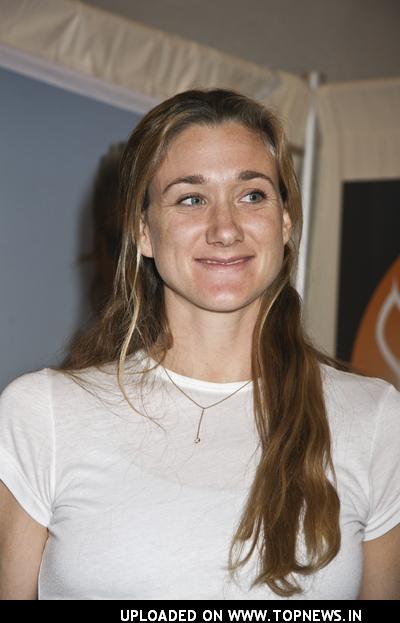
Kerri Walsh inspires me. No, it’s not her delicate and (far too) trim figure, nor her radiant face (although that is a necessary part of this deduction), nor even her mastery of her craft. In fact, it is her sheer radiation of what we call joy, pure 100% Joy, that gets my higher sense in gear; that is what inspires me.
The joyful—and that truly is the best word for it—display that she and her partner Misty put on after winning a gold medal for America stirred a surprising phenomenon inside me that lies somewhere between thought and emotion—Emought, or perhaps Thotion? No matter.
You see, I began to wonder if Kerri Walsh might be an angel. If that sounds strange and sort of “out of left field” to you (and it most definitely will to the mass of sane mortals), I suggest you watch the celebration and interview footage from the Beijing victory broadcast. PERHAPS you will then understand my inclination. And no, I won’t provide a link to this video—Google it. I’m sure it exists.
So let us continue—
Joy is one of the raw materials with which Heaven is built. This may sound like mere inspirational mumbo-jumbo, but like most things that sound that way, it is a true and thoughtful statement. Would any everlasting kingdom founded without Joy as a primary building block have any hope of ever lasting? No—Joy is one of the most enlivening and inspiring elements of human existence; it keeps all of its practitioners young. One might say it makes all things new.
Thus, the ability to wield this weapon (for Joy is also an ultimate weapon in the fight against evil) so purely and so beautifully (and I mean that in the spiritual sense) would almost definitely indicate a supernatural being. Am I being unreasonable?
Such unadulterated Joy is a rare occurrence; one sees it in babies and young children; in some of our number who are mentally handicapped; and, blessedly, in the occasional Aged who has lost the ability to speak, or perhaps walk, or perhaps think straight. But to see this beautiful energy in a fully-grown human being, particularly one so heavily publicized and televised as Walsh, is a vision that rarely graces our lives. To use one of my brothers’ superb phrases, it is “a joy to behold.”
It’s funny how that works, isn’t it? Joy causes Joy. Like all good things, even like cellular life at its most basic level, Joy is a multiplicative phenomenon—it creates fellows. As Confucius once put it, in a quote that—much like Kerri Walsh—inspires me:
“Virtue is not left to stand alone. He who practices it will have neighbors.”
True Joy attracts life and Love. It is one of the keys to blessedness. Angels, I hear tell, seem to have the whole blessedness thing down pretty well. When you look at it that way, Kerri Walsh just might be an angel.
Iron Will
I recall doing something recently that I immediately regretted, and thinking disappointedly “If I had perfect self-control, I wouldn’t have done that.” But what came next was a stunning realization: over every conscious decision I make, I have total control.
But this is a contradiction with my prior thought: “IF I had perfect self-control…” Clearly, I was wrong in thinking this. It is undeniable fact that every conscious decision I’ve ever made was initiated and guided by me. So, in reality, I do have perfect self-control, and so do you.
You see, this is sin’s evil little secret—it has no real power unless we give it power. The devil, as it has been said, can only enter your house if you let him in. Once we truly understand this fact, sin’s danger is lessened because its mystery is lessened. We are able to peer into the inner workings of this nefarious machine and observe—if only for a fleeting moment, like a lightning flash—the deceptive smoke and mirrors it relies on.
But we can’t do it alone. Here’s where we delve into some theology. We can only capitalize on this realization if we ask God to work inside us. Only He possesses the power to master and dispel sin’s power, because He is the source of all creation, including our free will, our “perfect self-control.” We can put our trust in Him, or we can go it alone and accept eternal failure.
Full comprehension of this idea puts a refreshing coat of appreciation on the Catholic Prayer of Contrition:
“Oh my God, I am sorry for my sins.
In choosing to do wrong, and failing to do good,
I have sinned against You, Whom I should love above all things.
I firmly intend, with Your help, to do penance, to sin no more, and to avoid whatever leads me to sin.”
(Yes, I added the bolds; I don't believe those are present in the official Roman documents)
“This is the thrilling romance of Orthodoxy. People have fallen into a foolish habit of speaking of orthodoxy as something heavy, humdrum, and safe. There never was anything so perilous or so exciting as orthodoxy.”
—G.K. Chesterton
20080227
Sweeping The Nation…into the dumpster
As time presses on in its sometimes wonderful, other times rather confounding way, man’s philosophy continues to advance in an inspiring pattern of upward evolution…right?
Actually, no. The things that work for us right now, the philosophies of life that really satisfy the heart and improve the world (what more could we ask for than those two ideals?), have been with us for a very long time, indeed. No one is going to dream up the meaning of life today. If one believes he has, he most likely not birthed a revolutionary new worldview, but instead merely realized for himself some particular aspect of the same great ideas that have satisfied the heart and improved the world throughout history.
So hold on a minute. Does that mean that the new philosophy of “Freeganism” breaks no ground in the area of ethical principles?
Well, let’s talk about what Freeganism is, and you can decide for yourself.
Freeganism, as described on Oprah, --
Wait. Did I just say that? Allow me to explain.
I was mugged yesterday, and when I woke up I was tied to a chair in a Chicago warehouse and forced to either watch Oprah or undergo intense psychological abuse (What's the difference? Ha-ha-ha-ha!!!). After ten minutes of quiet introspection and deliberation, I chose Oprah.
There, that’s better.
So they had this woman on Oprah who described herself as a “Freegan.” Basically, the Freegans are people who are fed up with the current economic system in America. To manifest this frustration with the system, they simply choose to withdraw from it. They abstain from buying food from any business or individual. Instead, they opt to forage through dumpsters and garbage bins, essentially living off the waste of their fellow citizens.
Jesus said that those who exalt themselves will be humbled, and those who humble themselves will be exalted (Matthew 23:12). Evidently, the Freegans choose to sidestep this dilemma, and instead attempt to exalt themselves and humble themselves.
I see two problems with that.
First of all, they’re exalting themselves. By showing off their alternative lifestyle to Oprah and anyone else who will listen, they are not, as they might contend, living out a life of principle. They are acting out in order to get attention. They are the logical maturity of the child in our 1st grade class who ate food off of the floor, to rounds of raucous laughter and applause, or (as the case might have been) general bewilderment and distaste. The Freegans are not living out their principles. If they were, they could emigrate from America and its unjust free markets.
To the Freegans, I have this to say: I hear that the summers are to die for in China.
Wow, they cleared out pretty quick after that. The point is that no sane human being would ever leave America's economy in order to support a Communist economy. Say as much as one wants about cooperation and equality and universal healthcare, no Communist system has ever really panned out as well in practice as it did on paper. America is the country that offers the best odds of success, from a purely practical standpoint. And, incidentally, America is also the country that allows people to dig through trash to make their livelihood.
It is not principle that drives these people, because they choose to remain in America rather than move elsewhere. It is attention, perhaps with some scorn thrown in (scorn being one sentiment that always makes one feel righteous and justified, even when that’s not the case), that they seek.
So the Freegans are not as self-sacrificing as they might present themselves. In fact, upon close observation, we see that they are more self-centered than anything else.
That brings us to the next point. If you’re going to be self-centered, do it right! More seriously put, I mean to say that no human being should eat another’s garbage. If the Freegan sees this action as a gesture of humility, he should perhaps study up on what true humility is. Ebenezer Scrooge was the epitome of self-centeredness; but all it took was three Spirits to cure him. To cure a Freegan, one would need a generous mess of Spirits and several cognitive psychologists.
No, I’m not saying I have all of the answers about being humble (Although I do have one! See below…). I’m just saying that the Freegans have none of the answers. And in another sense, they show us what one of the answers isn’t.
So that’s about it.
Have a great one, and if you get hungry, please approach the front of the restaurant, rather than the back.
Signing off,
Joezilla
Subscribe to:
Posts (Atom)