20160118

Video Games, Star Wars, and the Value of Crisis

How many of these characters did you watch back in the day?

One of the many quiet joys of being a twenty-something is witnessing a firsthand demonstration of the maxim “Everything old is new again.” Adolescents of today can look forward to someday seeing their favorite childhood toys and games suddenly return to relevance and enjoy fifteen more minutes of fame. Characters whose stories and theme songs fueled the minds and hearts of so many little lives not so long ago are almost destined for an eventual comeback, at the very least, on the t-shirt rack at Kohl’s—if not in full reboots of TV shows and movies. Ninja Turtles, X-Men, Pokemon…it only takes about 15 years for something popular to become venerable.

If you recognize this man, you remember the depth of the Sabrina episodes of Pokemon. What a great twist that was!
Do you recognize this man?
This is a great thing. Nostalgia brings out the innocence that is often lost on the road to adulthood. While reminiscence about an old cartoon or movie sometimes leads to smug smiles at the simplicity or absurdity of our quondam entertainment, it also reinvigorates a flame of reverent childhood loyalty that cannot be totally smothered, even after many years. 15+ years after I first watched it, Pokemon is a recognizably absurd series. Yet some of its story arcs—the Psychic Sabrina episodes, for instance—were so exciting to my 4th-grade self that I cannot but look upon the show with undying approval.

If you're too young to remember this firsthand, I feel just a little sorry for you. It was pretty amazing in its day.
I hope you are old enough to remember this. It was grand.
A consequence of this phenomenon is the sudden value that certain items gain after a given interval. Video games in particular have an odd lifecycle that follows the pattern: a new game, fresh from the factory, commands the heftiest price; as years go by, it descends into the related realms of sale and clearance items, and after 5 to 6 years all but the most wildly popular of games are, it would seem, lost to history. But most games are destined for a resurrection. Given about 20 years, many regain their majesty on the market. For proof, simply search eBay for any 8 or 16-bit game you played in childhood. Hundreds of such games are now hot commodities, sometimes commanding their original prices once again.

We've come a long way, baby!
This should come as a surprise to us, because video games do not age well. Each successive generation of video game technology vastly outstrips its predecessors in ways that emphasize their weaknesses and highlight their seams. The first 16-bit games on SNES and Sega Genesis drew attention to the pixelated figures and simple color palettes of the 8-bit pioneers on NES. The first great 3D game, Super Mario 64, literally brought video games into a new dimension—and showed gamers how trapped they’d always been in side-scrolling 2D worlds. The best moments of turn-of-this-century gaming brought us close to photorealism in games like Gran Turismo 3: A-Spec, and made previous games look like Tron with their embarrassingly obvious polygons. Years later, graphics continue to make flabbergasting strides and games become deeper and more immersive, all leading us to a rather sobering conclusion: the games that used to drive us up the wall with excitement simply aren’t that fun anymore.

Fire Mountain, Diddy Kong Racing: one of the few, the proud.
OK, stop. If you’re a longtime gamer, you are currently drawing up a list of games that prove me wrong. Fine. Draw up the list. You’ll find that it contains about 10 titles that are so incredibly awesome that time barely dims their light. These are the exceptions that prove my rule. If you go back and try the other games, the ones that you haven’t played in over a decade, you’ll find that most of them leave you feeling hollow. They just aren’t that deep. They don’t look so amazing now. And if you go back far enough, the music is absolutely horrendous. And why, you’ll find yourself asking, did we tolerate a world where games were so insanely difficult? How did I ever get past Level 1? And why did I even want to?

The reason is simple. But first, we have to talk about Star Wars.

The Falcon is flying again, but to unexpected destinations.
Many viewers of Star Wars: The Force Awakens left the theater disappointed in how things have turned out for the heroes of the original films. I found myself wondering why the writers chose to take these great characters through such trying experiences and lead them to such grave outcomes in what was supposed to be their triumphant return to the screen. The world has had over 30 years to write the rest of the Star Wars story, and even those who gave it a modicum of thought would conclude that Han and Leia married, had kids, and joined Luke (and why not Lando, too?) on dozens of whirlwind adventures around the galaxy. Pretty much every one of these escapades ended with Han whooping in victory over the comlink of the Falcon, Leia gazing at him with the perfect balance of annoyance and adulation, and Luke grinning in quiet satisfaction as the day was saved and the heroes returned to safety.

That is not what happens in the new Star Wars. Far from it. Far, far away from it.

And here’s the point: while it might have been fun to bring out the old horses for one more lap around the barn, just like old times, I think it would have left us feeling hollow, like playing those old Sega Genesis games. The past worked well, but it is now the past. We have to let it be.

What will Luke's story teach us in future Star Wars movies?
The new Star Wars movie may not give us the brand of romantic fun we were expecting, but it tells a story—and to do that well, it needs to twist and turn, to surprise us. A new crisis can compel us in ways that an old cliché cannot. Seeing our favorite characters face serious crises forces us to identify with them in different ways. Perhaps Han represented redemption to many viewers in the original films; now his character demonstrates that redemption is not a one-time deal, but must be renewed and carefully developed in order to retain its initial power. Luke’s storyline already showed us the rewards of patience, discipline, and indomitable hope—and now, perhaps, we see that even the greatest hero can fail, lose his vision, and need help in regaining awareness of his importance, his power, his indispensable role in the fight against evil.

I contend that we will be more satisfied seeing new crises in the Star Wars universe than recreating the dynamics of the past, for the same reason that our old video games often can’t seem to fulfill us in the way that they used to. Time brings change, and change means new circumstances which require creative thinking and different solutions. As Jesus said, “No one puts new wine in old wineskins.”

This was highly re-playable in 1995. Now, not so much.
The old mindsets, the old solutions, were great for their time. They worked…or they didn’t work, and we learned from that. Either way, the past is what it is, and we can take from it however much or little we like. But to try to live in the past, or read your present experiences solely through your past ones, is a dangerous recipe for backward living. We need to take on the challenges of our day with hope and openness, and accept that they may require us to change in some positive way. We need to let crisis bring out the best in us. In the same way, we can revisit the games, shows, and movies of our past and value the entertainment they gave us. But we live in those past worlds at the expense of the present one. It is fine to escape now and then, but we must not get lost in our escapism. As fun as it is, you can only replay the “Sergeant Snot” level in Earthworm Jim so many times before it becomes boring.

Our worlds change subtly every day, every year. It takes a while for us to discover the changes, but every now and then they hit us as we remember old friendships or see a picture from a previous era of our life. How will we respond to those changes that are still ahead? Will we allow our future self to take the best of what we’ve learned and apply it to the new crises that await us? Or will we simply dig into the past and find ourselves unfit to face the future? That is the constant question, and each of us has the power to answer it as we wish. May the Force be with you, always!

“In a higher world it is otherwise, but here below to live is to change, and to be perfect is to have changed often.”

—Blessed John Henry Newman

20150721

Why I Said "No" to Online Dating


Introduction

Note: This is not a slam on online dating sites. Several good friends have begun healthy and awesome relationships via sites like Catholic Match, and I am not casting judgment on their choice or its excellent outcome. I am writing this to empower young singles who are being worn down by our relationship-centered culture, and to express my own reasons for choosing not to use an online dating site. Feel free to share it with anyone who might want to read it.

My brother Matt used to be a single guy. A couple of years ago, he met Theresa in a swing dance class. They hit it off, and the rest is [family] history. Their anniversary is coming up in a few months, and they are very happy together. Knowing that I am single and wishing to help change my status, he recently suggested I register with an online dating site called Catholic Match.
_

Near the end of the conversation, he boiled it down to a simple thesis: "There are lots of people out there just like you, young teachers who don't have time to go looking for dates. The question to ask yourself is, 'Why not?'"

I admit, I was tempted by his description of the site. It sounded like a veritable buffet of eligible women, trotted out for my perusal. But over the next few days, something odd happened. The more I actually considered the possibility of trying Catholic Match, the more answers to Matt's question ("Why not?") materialized in my head. And with them came the certainty that, at this point in my life, online dating is not the answer for me. I share my reasons here because, as you will see, they address the unhealthy mindsets that far too many of my generation have about relationships, marriage, and being single.

So without further ado, I present the Reasons I Said "No" to Online Dating.

1.  I don't want a relationship right now.

Okay, I know, I know. Most singles reading this are saying, "Well, I do!" But I'm not so sure of that.  I contend that, on some level, you don't. And here's why: you almost certainly have goals you want to accomplish, or questions that you want to answer, that will be much more difficult--if not impossible--to fulfill if you start dating someone or get married.

The fact is, relationships take time and money, and there are a lot of simple decisions--like how to spend your vacation time or that extra money you've been saving--that are rendered more complex when there is a significant other in the picture. 

And if relationships take time and money, then marriage and family take all your time, and all your money. That sportscar you were hoping to buy? Try and justify it when you've got mortgage payments due on your house, and a kid on the way. I'm not knocking family life, but I am saying that when you have other people to look after, fun naturally takes a backseat to reality and survival.
_

So what is it that you still want to do, that would be easier or more fulfilling on your own? Trip to Europe? Running a marathon? For me, it's music. I want to be a better saxophonist than I currently am. No matter what people say, I know that this goal takes time and commitment that a relationship would greatly hinder. So the time that I am single is a gift, a time to develop a skill that brings me joy, that makes me thrive on a deeply personal level.

So like I said, if you really think it through, you might not want a relationship (at least right this second) as much as you thought. Take care of unfinished business first, because you may not have the chance later on in life.

2. I'm not who I want to be.

So you feel like Marriage is in the cards for you, and you're wondering when you'll meet that special person.

But are you ready for it? Our society's high divorce rate would shrink to almost nothing if everyone would ask themselves this question before popping the question: am I ready to be a good mate?

When I look at myself, I know there are things about me that should change before I propose to anyone. There are virtues that need strengthening, vices that need addressing, weaknesses that would harm rather than help my potential wife and children. It is to these that I must turn my attention now, when I am single, rather than springing them loose on the other person once we have rings on our fingers.

Many people, when giving advice to impatient singles, will say that you should spend your single years making yourself into the kind of person you'd like to meet. This is great advice, but it slightly misses the point, because it presents Marriage as the reason for self-improvement. Marriage should not be our goal; become better for the sake of becoming better, because it's one of the best ways a person can spend their time. If you devote yourself to that goal and hope to one day be married, chances are that someday you will be.

3. Relationships for the sake of relationships are not relationships.

One of my favorite quotes on this subject comes from Joe Weber, who runs the men's style website dappered.com:

Ask yourself: why are you looking? If your answer is: “because I’m unhappy/bored with being alone, and I’d just really like to be in a relationship…” then you might as well be looking for a date on Jupiter.

The logic behind this statement is impeccable: relationships are about other people. A relationship for the sake of a relationship is not really a relationship.

Many people unconsciously assume that being in a relationship is better than not being in one. But this is absurdly false. Being in a relationship just because you want to be in one is a very self-serving, and potentially dangerous, mindset.

What is the point of your relationship, or why do you want one? Is it simply to fill a hole in you? If that is the case, the relationship will end up doing damage both to you and your significant other.

There has to be more. There has to be a goal in mind that is bigger than serving yourself. As Peter Parker said in Spider-Man 2, "There are bigger things happening here than you and me." He's right. There's a whole world out there, full of problems. Your potential marriage should be part of the solution.

4. Marriage isn't the answer.

The heart of the single person's frustration is the unfulfilled desire to have a significant other in their life. If only she had a boyfriend, everything would be great. If only he had a wife, everything would be grand.

Sorry to burst your bubble, folks, but marriage is not going to make you happy.

Alright, take it easy! I'm not saying that you won't derive happiness from marriage, or that you shouldn't get married. What I'm saying is that, if you think being married is going to solve all your problems, you're extremely and dangerously mistaken.

When two people get married, everything changes...and nothing changes. Marriage can provide many things that being single cannot--a full-time friend who has literally vowed their loyalty to you, deep emotional and physical intimacy, and (at least for a time) dual income, to name a few--but anyone who is married can tell you that there was no magic spell cast at their wedding (Wiccans excluded). The next day, they woke up and were essentially the same person that they were before they got married. Same like and dislikes, same habits, same insecurities and hangups.

Single people, think about all the times in your life that you expected complete fulfillment to come with some milestone. For me, it goes all the way back to buying a Gameboy Color and the "Blue Version" of  Pokemon. I just knew that if I owned that game, I would be happy forever. Then I actually got the game, and although it was AWESOME, it didn't grant eternal happiness like I honestly felt it would.

This cycle repeats itself in our lives as we grow older, even when we don't consciously think about it. Most recently for me, it was getting a full-time job. I thought that that would solve all my problems. While I do love my job, and it has proven to be everything I'd hoped it would be and even more, it is not the golden ticket to happiness I unconsciously expected it to be. In fact, it also brought new difficulties to my life that I didn't appreciate not having before I got the job.

If you are putting marriage on this kind of pedestal in your mind and heart, you must stop immediately. It will disappoint you, and you may rush into an unhealthy relationship assuming that marriage will fix everything. It won't.

If you're insecure about being single, getting married will not solve your problem. Your insecurity will simply shift to something else. It will not go away unless you work at it, which can be started and even finished while single.

Conclusion

I'd like to close with a movie quote that sums up the perspective that I hope more single people will adopt as they continue their journey. It comes from one of my favorite movies, Captain America: The First Avenger.
_

Steve Rogers, who will soon be transformed into the supersoldier hero of the film, is speaking to the gorgeous secret agent Peggy Carter. He mentions that he's never been dancing before. When Agent Carter asks him why, he responds:

"The past few years [during World War II], it just didn't seem to matter that much. Figured I'd wait."

"For what?" she inquires.

Cap's answer is perfect: "The right partner."

This charming and simple view can save single people a lot of unnecessary frustration and pain, and enable them to accomplish so much more in the time God has given them. I sincerely hope that this post is as helpful to read as it was to write.

Lovingly,
Joezilla

20150626

Opponents of Gay Marriage: What Do We Do Now?


So this is it.  The long-awaited Supreme Court decision on gay marriage.  Some people are elated, some people are miserable.  Others don't betray any feeling about the whole thing.

For those of us who oppose gay marriage, this may feel like that moment when your team gets knocked out of the playoffs.  We were so invested in this thing, and now it's basically done, right?  Now what?

That's a good question.  Start by realizing that the Supreme Court does not decide right and wrong; all they have decided is what is legal here and now, in this particular country at this particular time.  Beyond that, I have a few suggestions to help us move forward in the right way.  So read on...

Blow it out your ears.

A decade ago, as a politically-engaged high-schooler, I eyed the changing statistics on Americans' view of Marriage with a mixture of apprehension and confidence in the common sense of my fellow citizens. My generation was already somewhat sold on the idea of gay marriage, but it seemed like there was still a fighting chance among rational adults. Anchored by the traditional views of the WWII generation, the public emitted the general silence that a cultural stalemate can sometimes produce.

Fast forward ten years. In a post-Glee world, with much of the Greatest Generation having passed on, the die has been cast--and there is nothing I or anyone else can do about it.  Yeah, I'm frustrated.

Like many supporters of traditional Marriage, upon hearing this news I was tempted to sprint into the public square in a desperate act of bravado, trumpeting my feelings through a Facebook status. But that will not do anyone any good (more on that below). Instead, I needed to simply let off some steam through private discussion and activity.


As the military sought remote areas to test nuclear weapons--like the desert or the ocean--so must you find an empty space in which to fire off your extra munitions. The army did this for a reason: so that people wouldn't get hurt. For you, it is no different. Find an outlet for your feelings of frustration and disappointment, an outlet that is not public. Talk to a trusted friend, pray it out, go for a walk or to the batting cages. Above all, do not vent on social media.

Avoid victimhood.

The second thing to do is to avoid feeling like something has been done to you, specifically. You have not been attacked by the Supreme Court. Marriage protesters have not ransacked your property. You are in the same condition you were yesterday. Yes, something you value (Marriage) has been trampled by misguided public (and now legal) opinion, and your pride in America has maybe become a shade more tarnished.

But be careful not to idolize America too much. For decades you've been saluting the flag of a country that allows the murder of unborn children. Why? Because the America you love is an idea and an ideal, not a set of laws or a group of leaders. So don't let gay marriage rain on your Independence Day parade.

Anyway, despite taking some cultural and ideological hits through this decision, you have not been directly hurt. So please avoid giving that impression in the words you speak about this country and this issue. Gay marriage supporters often cast us as feeling somehow threatened by them, or "afraid" of them. The victimhood mentality plays into this false view and makes it real.

It is possible to be against something without feeling fear or hatred towards its proponents. That needs to be made clear by opponents of gay marriage. We are not hurt or threatened by this ruling, but we are very much against it on ideological grounds. It's not personal; it's philosophical.

Don't dance to their tune.
Our next point is related to the last, but is broader. Supporters of gay marriage will be looking for certain signs in you, as anyone would in this situation. They will be expecting bitterness, disillusionment, hypocrisy, and particularly hatred. Oftentimes when we expect someone to act a certain way, we unconsciously attempt to draw the expected behavior out of them with our own words and actions.

Your job is to not let this happen. That means you need to be the most courteous, respectful, and classiest paragon of integrity that you can be. If you do this, there is always the chance that someone might see you and open their mind, even just a bit: "Wow, they really don't seem hateful or bigoted..." On the other hand, display any hint of bitterness or prejudice, and boom--they'll never even think about giving you the time of day, because you have confirmed the stereotype that they were taught.


So make your own music and don't play into the hands of those who would see you fall.  Don't get mad and jump around in circles on Facebook and Twitter.  That invites gloating, which is a recipe for angry and very personal debates, which will not help anyone.

This issue, to the extent that it is an issue now, has changed.  As someone who respectfully disagrees with the status quo and has good reasons for it, it is up to you to write the script for how the conversation goes now.  If you don't, then others will.  I'm not saying that you will change the world. But if you don't, at least you'll have died trying.

WWJD?

What would Jesus do?  It is high time for this catchphrase to make a comeback in Christian circles, because it will guide us with respect to this issue.


I don't believe that Jesus supports gay marriage. That is, in fact, why I don't support it. Jesus was all about love, but he was also a very careful and specific thinker: in Mark's Gospel he clearly endorses a vision of Marriage as the union of one man and one woman: 

But from the beginning of creation, "God made them male and female."
"For this reason a man shall leave his father and mother and be joined to his wife,
and the two shall become one flesh." So they are no longer two but one flesh.
What therefore God has joined together, let not man put asunder.
(Mark 10:6-9)


That said, Jesus would also not log in to Facebook and post his angry rantings, itching for a fight. He would not lash out at anyone. He would quietly accept what happened and move forward in his mission to save souls. And everything he did would be done in love. Because in the end, the world does not stand or fall based on the U.S. Supreme Court's definition of Marriage.

This is not the time for debate, it is the time for evangelization. Now more than ever, this country needs people committed to the truth, living out their commitment in inspiring ways. There simply is no room for anger and bitterness in this convoy.  If you truly believe in the Gospel, does it make any sense to get angry?

Instead, follow the advice of St. Paul, some of the best advice you'll find in the Bible:

Keep alert, stand firm in the faith, be courageous, be strong. Let all that you do be done in love.
(1 Corinthians 16:13-14)


Do you believe in traditional Marriage? Then do what you can to support it. If you are married, strengthen that commitment, that bond. Do something to make it healthier.

Are you single, looking for the one and only? Make sure you are ready for such a sacred and binding commitment as Matrimony. Pursue in yourself the qualities you would value in a mate, and don't settle for less.  Be patient.

We must never compromise on our beliefs, and be prepared to articulate them if called upon to do so. But all that we do must be done in love.

In Conclusion...

This is going to be a strange time for everyone. Do your best to be a rock of stability and wisdom for those God put in your life. And don't forget to smile!

20150623

The Power of Discipline

I was struck today by the power of discipline. I had spent the past week practicing saxophone every day, carefully limiting myself to about 20-25 minutes in order to keep my appetite sharp to play again the next day. Consumed by Father’s Day activities over the weekend, I was unable to practice on Friday, Saturday, or Sunday. Slightly dismayed at the prospect of missing out on crucial days of playing, I nonetheless dutifully set up the horn Monday evening for some late-night practice. I couldn’t have predicted what happened next.

Rather than backsliding because of my lost days of weekend practice, I found my abilities vastly increased since I last played! I was able to play longer, sweeter notes and run through scales with refreshing ease. Every note was a joy to play, which incidentally is the ideal I strive for at all times on the sax.

I realize now that I had been focusing on the negative effects of missing a little bit of practice, and completely forgetting the positive effect that an entire week of dedicated practice would bring about. Two ideas spring from this realization:

1. Discipline is extremely powerful. It’s amazing what repeated practice of an important or valuable action will do for you. You will become great! One of my favorite authors, Matthew Kelly, compares discipline to water in a creek. He says that practicing something consistently is like the water of a creek, which sends a small amount of water through the creek every second. The creek begins very small, but over time (we’re talking thousands, even millions of years) it carves out a larger space for itself in the rocky bed of the creek. Eventually, the water of the creek wears away more of the rock, and the creek becomes a river. Now if you had taken millions of gallons of water and splashed it onto the creek bed all at once, like a tidal wave, it wouldn’t have carved out a river. It would’ve made a big mess, dried up, and looked as if nothing ever happened. But the dedicated, consistent stream of the creek is unstoppable. Yes, it takes time, but the result is impossible by any other method.

2. Rest is important in any routine. I found that the weekend of no practice actually helped me more than it hurt me. Marathon runners actually build rest days into their intense workout routines. Anyone who exerts themselves greatly must rest, or they will end up hurting themselves in the long run. Therefore, rest is vital to any routine of discipline or practice. 

In the story of creation in the first chapters of Genesis, God creates the universe in six symbolic days, then rests on the seventh, known as the Sabbath Day. This is not just a whimsical detail of the story. It is meant to demonstrate to us the importance of rest in routine. If God Himself rested after doing His work, doesn’t that mean that each of us needs to learn to take a load off? I certainly think so. And for your sake, I hope you do, too, Dear Reader.

 So I close by asking you, what is your discipline that you have neglected?  Exercise?  Reading or writing?  Some form of athletics?  Music?  Whatever it is, I urge you to be creative in how you approach this discipline.  Practice it consistently, making sure it can easily fit into your daily routine.  Practice it wisely, finding efficient (and perhaps new) ways to become dominant at the skill or ability you value.  Finally, practice sparingly.  Be like the water in the creek, just a little bit each day.  Don't overdo it, and you'll often have the desire to practice consistently.  And when you don't?  You won't have the excuse of "it takes too long."

Happy practicing, my friend.

Determinedly,
Joezilla

20150408

Why Do We Pray?

The question: Why do we pray?  In particular, why do Catholics pray to the saints for intercession?

The skeptic's charge: Intercessory prayer is a holdover from more superstitious days, perhaps even a mingling of pagan customs with the pure monotheism of the Christians. It is philosophically absurd and unnecessary to suppose that dead human beings can somehow change God's mind about things in order to answer our prayers. Were He to exist, why would He set things up in such a way? Isn't He all-knowing and all-powerful?

For that matter, why do we have to pray at all? God supposedly has a plan. Either He changes it based on how many reverent words we repeat, or our prayers mean nothing at all.

The answer: We start with the words of Father Robert Barron: "God does not need us." He is completely happy, completely complete, on His own. But because He is perfection, He wants to share that perfection with more than just Himself. That is why He created us--to enjoy His greatness, and even share in it.

Now hold on for a second. Some of you are thinking, as I was once tempted to consider, that this is a pretty egotistical thing to do. Who does God think He is, to create a bunch of things whose sole purpose is to tell Him how awesome He is?

You'd be right, if God were not actually fully awesome. If we could imagine something or someone better than God, then we'd be right to criticize this notion of creating things just to share His glory.

But that's not God. When we say "God," we're talking about the one thing that has no equal, no competitor. Our very idea of perfection comes from Him. So the greatness of God is not negotiable. Were we to somehow experience it directly in full force, we would understand.

Okay, so God doesn't need us. This doesn't seem to be helping explain the case for why we pray, but it actually sets up the whole solution: God created the universe in such a way that prayer works. My praying for my sick brother may actually help him to be healed or eased of suffering. Realizing we have this kind of power is amazing. And the reason we have it is that this is the way that God invites us into the story.

In Disney World, there is a ride called Mission: Space, in which groups of four people take a "space shuttle ride" to Mars, seated in a high-tech cockpit with all sorts of illuminated buttons. Each rider is given a role in the mission, which requires them to press a certain button at a certain point in the ride. This aspect of the ride is completely unnecessary; Disney could have designed a space ride with no buttons, no interactivity at all. But including it makes the ride all the more enjoyable, because it sucks riders into the experience in an exciting way. By inviting us to pray for ourselves and other people and events, God is really drawing us deeper into the great human story.

How, then, is He an all-powerful and unchanging God, if the prayers of mere mortals can turn His ear? Well, the act of prayer is not to be understood as changing God's will to something different, but in bringing about what was already planned by God from the start. You say your friend was sick, but became healed after you prayed over him? Catholic faith says, not that your prayer meant nothing because God always planned to heal your friend, but that God always planned to heal your friend through your prayer. Yes, we actually believe that answered prayers are examples of God's power working through us, through our bodies, minds, and spirits all tuned in to the divine frequency. Pretty cool, eh?

Our prayers do not always conform to God's will, which is why they are not always answered. But that doesn't lessen the reality that prayer sometimes is answered, because it is part of God's plan. So if there's a problem, start praying about it--you could be part of the solution God has in mind!
Okay, so that brings us back to the initial question of intercession of the saints. Why? How is this not just some whitewashed form of ancestor-worship?

No offense, Mulan!

Simply this: who says that the power of prayer should cease when a person dies? Should it not actually work quite the opposite way? Ask me to pray for your ailing cousin now, and I'll squeeze him in between my drive home from work and my dinner--if I don't put other things ahead of praying. But sometimes I do, because I'm a human being living a life full of distractions and temptations.

After I'm dead, though (assuming I'm not roasting on a hot stove somewhere), my schedule will be freer, my priorities considerably straighter. Why would you think a dead person's capacity to pray for your intentions is diminished by earthly death?

I ask this not to mock you, but myself. For far too long I left this question unanswered and allowed the uncomfortable silence to be filled by the skeptic. I am glad to finally be able to shut him up.

20140528

Has Neuroscience Disproved the Soul?


What if I told you that all the interactions you’ve ever had on Facebook—shared pictures, comments, wall posts, the whole kit and caboodle—are just a bunch of computer data, a series of ones and zeroes stored on a server somewhere in California?

Would you stop using Facebook? Probably not.

There are some people who discount the possibility of a soul simply because we can scientifically account for every thought and emotion a person experiences. The argument is that, since everything that goes through our brains—random thoughts, creative ideas, and unconscious reactions—can be reduced to a chemical reaction, electrical current, or other observable phenomenon, the idea of a soul is impossible. To put it more simply, this argument says that there is no room for the soul in the brain. Since we can account for everything in the life of the mind, how can the soul possibly fit in?


The answer is simple. Science can observe physical phenomena, but it cannot describe the full breadth of human experience. Science is one valid perspective on life, but it is not a comprehensive system of understanding, nor is it meant to be. Science is a practical art that leads to greater knowledge about the universe, thereby increasing our ability to thrive within it. However, it is not a system of philosophy.

One who allows his scientific conclusions to entirely dictate his view of life is akin to one who sings everything he wants to say. Singing is fine activity and has its place in life, but it should not be the only way to communicate. In the same way, science is important and admirable, but cannot claim more than its due share of our understanding.


So if I tell you that all of your Facebook pictures are just ones and zeroes stored on a server in California, are you going to stop uploading them? No. On the contrary, you might say something like this: “A programmer may be able to see them as ones and zeroes, but they have a much greater meaning. Those ones and zeroes add up to become a picture of me and my family on vacation in North Carolina.”

 
In the same way, the physical and chemical reactions in our brains add up to much more than mere physical phenomena. They are the physical representations of the thoughts, feelings, and memories that make up our lives. There is something much deeper to a human being than simple physicality. Even though we can’t see it, we know it’s there. And we call it a soul.

Thoughtfully,
Joezilla

20140521

Don't Forget Your Uppercut


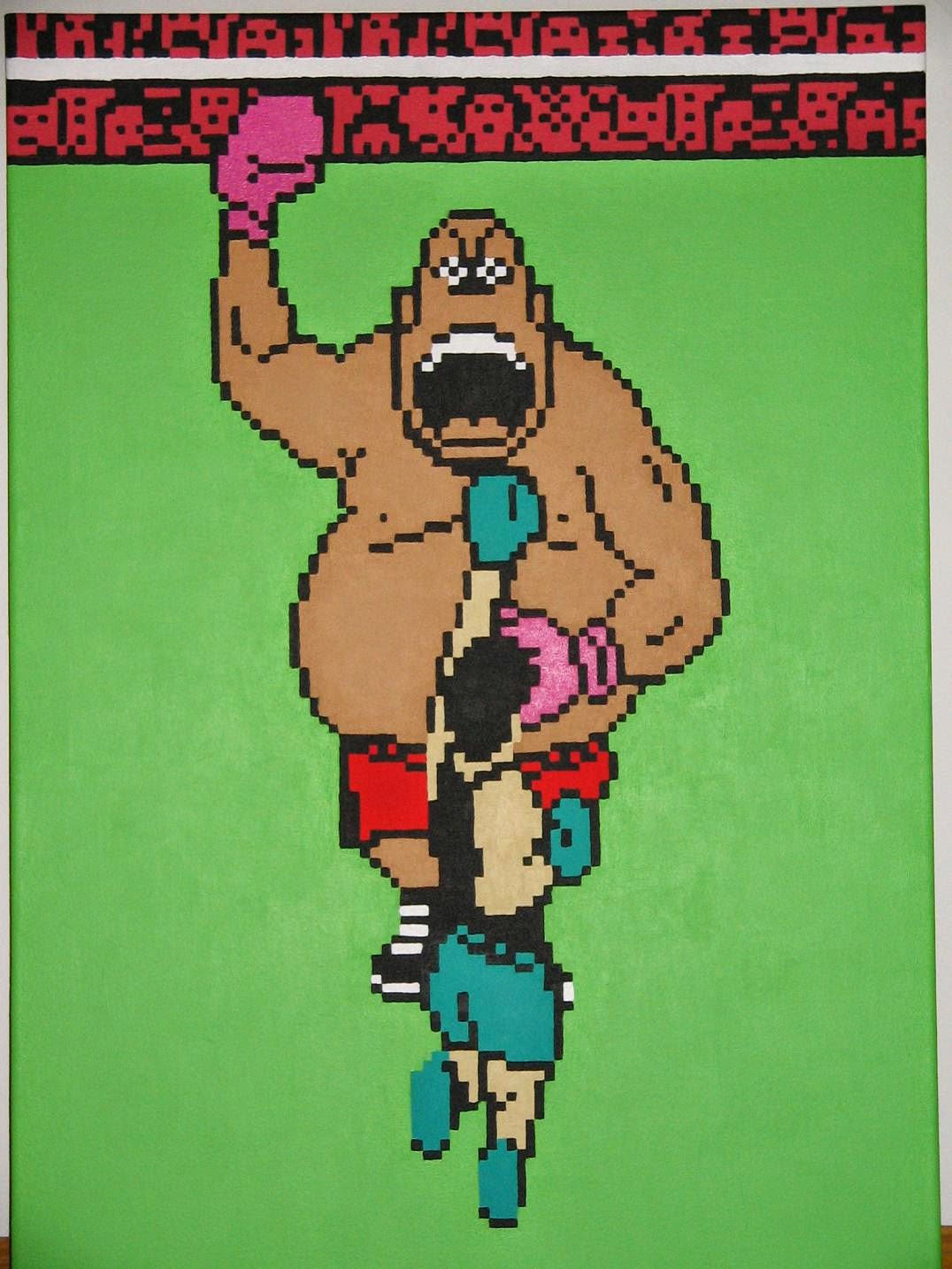
Growing up in the ‘80s or ‘90s, it was a well-known fact that the “start” button paused any and all video games. However, there was one glorious exception to this rule: the uppercut in Punch-Out!

For those who never knew its exhilarations, Punch-Out! was an extremely popular boxing game on NES in which players entered the ring as Little Mac, a pint-sized runt who, through some highly unethical breach of WBA regulations, faced a series of monstrous opponents two or three times his size.


But Little Mac had two advantages: first, his determination to fight and win; and second, the human being controlling him.


Still, once the bell rings and Mac’s first opponent ambles forward, apprehension never fails to kick in. The fact is, the guys you face in this game are huge. Some of them can make mincemeat out of Mac with just a few punches. Mac’s punches, on the other hand, come off as depressingly anemic. Then again, what more could you expect from a guy who has to jump a foot in the air to reach his opponent’s chin? But this little guy is not without his trump card.


Into this daunting situation, Digital Providence has tossed a happy surprise: Mac’s signature move, the spinning uppercut. It takes a lot out of Mac, and is only possible when his confidence is up after scoring a particularly effective shot against an opponent—but when he’s able, Mac spins around, spirals into the air in a dazzling five-foot vertical leap, and drives his little fist straight into the adversary’s unsuspecting face. All this is triggered by pressing the “start” button.


This is quite literally a game-changing punch that has the power to instantly lay out some opponents. And when it’s timed right, this baby is still—in the age of ultra-HD graphics and super-intuitive game engines—still one of the most satisfying moves in all of Video-Gamedom.

So why bring it up now, other than nostalgia?

Sometimes I feel like Little Mac. You know what I mean. Up against huge problems, thinking things like, “I am way out my league here!” or “I shouldn’t even have to deal with this!” or “Why am I boxing with a mutated, 300-pound hippo-man?” Well, okay, only Little Mac has thought that last one, but we’ve all been in the ring with people or problems that seem to vastly outweigh us. And we have felt that primal fear, that deep sense of inadequacy.

It is at these moments that we need to remember the spinning uppercut. There is power, there is greatness, placed within you. Find it and claim it. Don’t be afraid to use it. Never fear greatness, because greatness is your destiny.

And there is nothing more satisfying than feeling that spinning uppercut hit its mark!


Confidently,
Joezilla

20140513

The Eternal Losers and The Power of Christ


Were you as creeped out as I was when you heard that there might be a consecrated host at the Harvard black mass?  While the fight to get it cancelled was totally worthwhile, here’s why you can rest easy tonight regardless of the outcome.


I admit it--when I heard that a Harvard student group was sponsoring a “reenactment” of a satanic ritual involving a potentially consecrated Communion host, I was not only angry, but also a little scared.  After all, Catholics believe that the consecrated host is Jesus—not a symbol or a reminder, but Jesus, truly present, in the flesh and blood.  While we agree with outside observers that the physical characteristics do not change, we believe that on the level of its identity—its substance, to use the theological language—it is truly, really, totally Christ.

So if somebody who hates Christ (or thinks they hate Christ, because if they really knew Him they would almost certainly love Him) gets a hold of one of these consecrated hosts, I start to wretch at the possibilities.  Though I had always brushed such thoughts under the rug of my conscious mind in the past, this Harvard story made that impossible.

Thankfully, God (Who cannot be abused, hurt, or controlled by any of us idiots down here) decided in His mercy and goodness to show me why such worry was unfounded.  Take a look at this post from Elizabeth Scalia’s blog, which talks about why such satanic rituals do not actually possess the power they claim to have:

“Christ gave himself to us, freely, of his own free will. A Gift freely given. If someone takes the Gift and spits on it or whatever — they’re only destroying what was given to them, they are destroying what is ‘theirs.’ They don’t in any way destroy the Giver of the Gift, or lessen the Giver, or the Gift. So they have no power over it, they can’t dominate it. All they can do is destroy themselves within themselves.”

 
The consecrated host is the presence of Jesus, but Jesus is a suffering servant who submitted himself to extreme denigration and humiliation for our sake.  His presence in the Eucharist is that same gift, which we are free to accept or reject.  While desecrating the Eucharist is an outrageously sinful act, it does nothing to injure or even demean God Himself.

Simply put, they have no power over God!  They never could.  And while we’re bashing devil-worshippers, I’ve also always wondered why, if someone believes in God, they would purposely choose to “worship” the guy who got kicked out of Heaven by God.  Purposely picking the loser—isn’t that sort of like choosing to play as Jigglypuff in Super Smash Brothers?  But I digress.

 
Now, mind you, I’m not trying to minimize the reality or power of the devil.  He was created as an angel—which means that, in terms of creation, he’s way more powerful than any of us on our own.  But we have ways of keeping him at bay and protecting ourselves.

I remember the advice I got from someone on the beach in Hawaii: never turn your back on the tide.  If you do, it can kill you.  It’s so easy to write it off as nothing, but people have literally been swept away by creeping tides that unexpectedly descended upon them when they turned their back.  Satan is much the same way.  Always keep one eye on him, and be aware that he is actively trying to mess with you.  Whatever you do, do not write him off as a legend or a myth.  As they say in The Usual Suspects, “the greatest trick the devil ever played was convincing the world that he doesn’t exist.”  Don’t fall for it.  He’s out there, and he doesn’t like you.

But the good news is this:  God has given us a protector who has already once beaten the tar out of Satan, and is totally willing to do it again whenever we call upon him: Saint Michael the Archangel.  This supernatural guardian—who, I contend, must actually be way more ripped and imposing than the girly-man he is usually depicted as—is more than willing to step up and defend us from the devil whenever we ask.  Take a look at the statue pictured below.  Now we're getting somewhere!  That's more the Michael that I believe in.

 
And since, in writing this post debunking his followers’ false power, the devil may be a little extra peeved at me, I finish with this prayer—in which I have complete faith as a means of protection from all the attacks of the evil one:

Saint Michael the Archangel, defend us in battle.  Be our protection against the wickedness and snares of the devil.  May God rebuke him, we humbly pray, and do Thou, O Prince of the Heavenly Host [remember, that means army!], by the power of God, cast into hell Satan and all the evil spirits who prowl about the world seeking the ruin of souls.

Amen.

Now, let’s say it again!

Confidently,
Joezilla

P.S.:  Read the whole post at Elizabeth Scalia’s blog here.

20140222

12 Years A Slave: Feel-Good Movie of the Year?

Why was I clicking my heels in the parking lot after seeing this movie?  While you might be inclined to suspect me of insanity, the truth is quite understandable.

But first, let’s be clear: 12 Years A Slave is absolutely not a “feel-good” movie.  It is an intense and gritty immersion into the inhumanity of slavery, the racial and sexual injustice of past societies, and the disturbing potential for human depravity in every age.  It contains scenes of brutal torture (less bloody but about as intense as The Passion of the Christ) and is speckled with cruel and dehumanizing speech.  There are very few punches pulled in this movie’s presentation of historical realities.

It is even-handed in its approach, presenting slave-owners as the mixed bag of humanity that they surely were—though all were complicit in a morally offensive societal structure, some no doubt treated their slaves with a degree of civility or even kindness, while others inflicted unspeakable evils upon their fellow men and women.  The film shows examples of both, though it centers on a particularly disgusting example of the latter type.

In short, for those who have not yet seen the film, it is likely what they expect it to be: intense, eye-opening, moving.  However, all this serves to intensify the question of why I would feel happy after seeing this movie.  Patience is a virtue, and it’s time I rewarded you for it.

12 Years A Slave made me feel exceptionally grateful.

I take many things for granted, you see.  My family.  My home.  My freedom.  The basic civility and social decency of the people I meet in the world.  The fact that people (mostly) stop at red lights.  These things come to mind easily when I try to name them, but on a typical day I am not overcome with gratefulness for them.

Have you ever rear-ended a car on the street?  I did several years ago, and the first feeling I remember having is a sharp double-edged regret.  The first edge was, of course, regret at being distracted and running into that Chevy Tahoe’s bumper; the second was subtler, but no less real: I regretted not appreciating what I had before the hit.  Before the hit, I had a certain insurance premium.  Now, it would go up.  Before the hit, I had a class I was going to be on-time for.  Now, I would be late.  Before the hit, I had a peaceful drive ahead of me.  Now, that peace was shattered.  The thought that went through my head was, “Man, everything was going so well before this happened…and I didn’t even know it!”

Whenever I pass a minor car accident on the road now, my heart pangs with empathy for those involved.  I’ll bet they weren’t appreciating what they had before the hit, either.

The protagonist of 12 Years A Slave, one Solomon Northup, is a victim of the same dangerous mindset, and his ordeals drive the point home about as effectively as 100 auto crackups.  Solomon is a free black man in New York prior to the Civil War (which is a really strange name for a war, now that I think about it).  Solomon has a wife, two children, a house of his own, and a profitable career as a violinist.  He is respected, applauded, and afforded the same rights and privileges of others in his society.  Virtue and discipline have played a key role in his success, to be sure—but in the final analysis, he is lucky.  He has been equipped by God’s providence with a healthy environment and good people.  And like many people in similar situations, and like me, he takes almost all of it for granted almost all of the time.

Suddenly, his world is plunged into chaos as he is abducted and sold into slavery under false pretences.  Laboring at the plantation of a warped and cruel man, Solomon slowly, painstakingly, surveys the depths of misery and depravity his race is subjected to in the pre-war South.

And soon those days back in New York take on a new light.  Suddenly, the veil is lifted and Solomon’s former life—which for many of us is routine, as it was for him—is revealed to be the Shangri-La that it really was.  And as the possibility of returning to it dims, every under-appreciated moment stings like another lash of the whip.  How he would love to go back and relive one of those “routine” days!  How different those responsibilities now appear.  What were considered burdens are understood as privileges.  And life’s great blessings are, for one sublime season, truly recognized.

By now, you might have realized that I am no longer talking about Solomon Northup.  I can’t speak for what he, the historical figure on whom the film is based, felt as the grim reality of slavery dawned on him each morning.  But I know how it made me feel to see his story dramatized, super-sized, and projected on the screen.

It made me feel happy.  Thanks be to God, now and forever!

20131021

A Song of Late October

A Song of Late October.

Upon the sun’s descending leave,
A hoot rings in October eve.
And out, against a lively breeze,
I venture through the fired trees.

Howls building from the south,
Issued from a hungry mouth,
Kindle daring mixed with fear:
The season of mystery is here.

Day by day, the rising tide
of color, cold, and fancy hide
anticipation for the night
of costume, candy, pumpkin light.

*    *    *

Howls fading from the north,
Old Man Winter plodding forth,
Trading chills for milder winds—
The season of thanks begins!

20131019

Loneliness: The Millennial's Plague

Loneliness is the virus that is killing our generation.

The online connections we can make, while they help us stay in touch, have also hyper-exposed us to one another.

We can have a 2-minute conversation with a stranger and gain access to a library of their likes and dislikes merely by friending them on Facebook.

After setting up a date, we can go ahead and find out everything we would've learned on that date. Rather than hearing it from the person, studying their face and looking into their eyes--connecting like real human beings, in other words--we can find out everything we think we need to know online. And then we wonder why we're so awkward with each other.

This is not another anti-Facebook rant. FB is not the enemy, but merely a piece of technology, a tool. It can be used for good or bad.

The enemy is much deeper and more sophisticated. The enemy wants us to feel disconnected, inadequate, lonely.

The enemy wants to make us forget that we are loved.

I have felt the signature emotion of our generation. It is a deep longing, buried so as to be almost invisible to us, in the back of our hearts. Its calls echo up to our minds and manifest themselves through our desperate measures in search of connection.

The longing burns like an inferno within us, and we long for connection, communion. But we aren't looking for it in the right places.


Consider the picture above. Yes, it's funny, but think about what it implies: that guy is miserable unless he can turn someone on. If we think that way, then we truly will be "forever alone," whether we find someone or not. The egotistical joys of pleasure are fleeting, and leave us feeling worse in the long run.

We think that romance will quench the fire. We look for a date. Sometimes we get absolutely desperate. We try. Sometimes we fail.

And we might find someone, even the right person, but we soon wake up and realize that, despite the ring on our finger, we are still the same. Life goes on. Turns out Marriage, wonderful as it is, doesn't complete our happiness like we thought it would. And that fire still burns.

We turn to friendships, sometimes. They help. They give us a true connection like Marriage, and they are an essential part of life, but they still do not complete us.


And so that feeling remains. You know it well. It's the one that somehow, time and again, gets you to scroll down that Newsfeed, looking...for what? The moment you stop, you realize that the Newsfeed is an infinite void that promises something, but never really delivers.

There is a deep emptiness within every individual. We are tricked into thinking it's our job to fill this emptiness, but we are running against a brick wall if we try. This space can only be filled. We cannot fulfill ourselves.

I believe in a personal God. God is personal because He is a person, He knows you as a person, and is open to relating to you that way. And there is nothing and no one in the universe powerful enough and big enough to fill that emptiness that burns inside you except for Him.

He made the space infinitely large so that He could fill it, complete our personalities with supernatural Love. Nothing else is going to cure our loneliness.

So how do we start to cultivate this relationship, if the loneliness we face has been weighing us down lately?


The answer is the opposite of what you would expect: go off alone for a while. Take a walk every day for a week or month, visiting public places and secluded natural hideaways. Eat a meal alone without reading or playing with a smartphone. And then, when your distractions and self-consciousness have melted away, you will start reaching for Him. You see, God is always there, but sometimes we shut Him out and the only way to get ourselves seeing Him again is to go back to the basics.

"You will seek me and you will find me," says The LORD, "when you seek me with all of your heart."

~ Jeremiah 29:13

20130908

Hail, Holy Queen

Hail, Holy Queen

Hail, Holy Queen, of mercy’s longed-for sweetness mother,
Hail to the living hope that soothes us like no other.

To thee we bring our anguish, as our fallen temple sighs,
To thee we open careworn hearts and focus bloodshot eyes.

Turn then, Blessed Mother, through your graceful intercession,
The eyes of mercy toward us as we offer this confession

To the One Who knew our fall and rise before the world was new,
The living God of Abraham Who came to life in you.

O clemens, O pia,
O dulcis Virgo Maria.

Amen

20130829

On the Feast of Saint John

On the Feast of Saint John

If ever kindly voice or act
Hath helped a stinging pain subtract,
And love to flower in its place,
Then know, I pray, its Source was grace.

The gnarled, hardened roots of pride
Have halted men of hopeful stride
Who dared to labor and to love,
But gazed inside and not above.

Oh! What suffering may cease
The day I say "I must decrease."
Oh! What springs erupt of peace
The day I say, "He must increase."

20130811

Why are you a Christian?

Today we echo Michael Scott's question to Toby on The Office, "Why are you the way that you are?"

If someone were to ask you why you are a Christian, what would you say?

If you are a Christian, you might be rather paradoxically dumbstruck in your attempt to answer. Do not feel bad; like me, you just haven't approached the question in a while. But now that you have been reminded of it, you have a duty to furnish an adequate and genuine response: "Always be ready to give a reason for the hope that is in you," as 1 Peter 3:15 says.

What follows is my reason.

God is present; His presence is as real to me as my own personality. My personality cannot be seen directly, touched or physically sensed in any way. But its effects are obvious to all who spend any measure of time with me.

God is the same way; the Father is not physically present (with the exception of Sacraments, which are a more complicated issue and require a deeper discussion). However, to say that God cannot exist because He cannot be physically accounted for is absurd. Surely we do not hold all things to such a careful standard as some seem to hold God.

The average atheist will discard God as a fairy tale because He is not an empirically verifiable reality. But the same atheist will then appeal to the ideal of Human Rights (quite rightly) in order to decry genocide in Africa. Where are human rights? What energy or matter comprises them? Can we find them if we search really, really hard?

Of course not. Neither can we find God. Like a pen pal on the other side of the world, God is there, communicating with us, even though we don't see His face. The cool part is that once we commit to a relationship with Him, God's presence invades our life more clearly than before, infusing our moments of sorrow with power and strength, and our moments of joy with perspective. That is precisely what happened to me when, in high school, I traded in my outmoded model of passive faith for a dynamic, searching love of Jesus Christ.

I am a Christian because I can feel God's presence, and believing in Jesus has only made God clearer to me. I am honored to say that Jesus is the Lord and Savior of the human race. I thank Him for the life he gives me, and the opportunity to praise him.

Jesus loves you! Reach out to him, and you will realize that, all your life, he has been reaching out to you.

Sincerely,
Joezilla